Quick answer
The best beginner turntable is usually one that is easy to set up, kind to records, compatible with your speakers, and good enough that you will not immediately outgrow it. For most first-time buyers, that means looking for a proper tonearm, a replaceable stylus or cartridge, stable speed, and clear connection options.
Avoid choosing only by looks, Bluetooth, or the lowest price. A simple turntable with sensible adjustment and separate speakers will often give better long-term results than an all-in-one record player, but convenience, space and budget still matter.
In this guide
- How to choose between all-in-one record players, Bluetooth turntables and traditional hi-fi turntables.
- Why the cartridge, stylus and tonearm matter for both sound quality and record wear.
- What a phono preamp does, and how to avoid buying equipment that will not connect properly.
- When automatic operation helps beginners, and when manual turntables are worth considering.
- Which convenience features are useful, including Bluetooth and USB, and where they involve compromises.
- A practical setup checklist for getting clean playback from your first record player.
Watch the article video
What “best” really means for a beginner
For a first-time buyer, “best” should not simply mean the most expensive, the most feature-packed, or the most stylish. A beginner turntable should make it easy to play records correctly while leaving room to improve your system later.
The main priorities are simple:
- It should spin records at a stable speed.
- The tonearm should track the groove safely.
- The stylus should be replaceable.
- The connections should suit the speakers or amplifier you plan to use.
- The design should not make setup harder than necessary.
A turntable that looks attractive but has weak mechanical basics can become frustrating. You may hear pitch wobble, distortion near the end of a side, excessive surface noise, or uneven sound between the left and right channels.
It is also worth separating the turntable from the whole system. A record player is only one part of the chain. The cartridge reads the groove, the phono stage boosts the tiny signal, the amplifier drives the speakers, and the speakers produce the sound you hear.
A modest turntable connected to decent powered speakers can be more satisfying than a visually impressive record player with poor built-in speakers. Beginners often get better results by spending less on gimmicks and more on the core playback path.
Choose the type of beginner setup first
Before comparing individual turntables, decide what sort of listening setup you want. This decision shapes almost everything else, including cost, space, sound quality and upgrade options.
The most common beginner routes are:
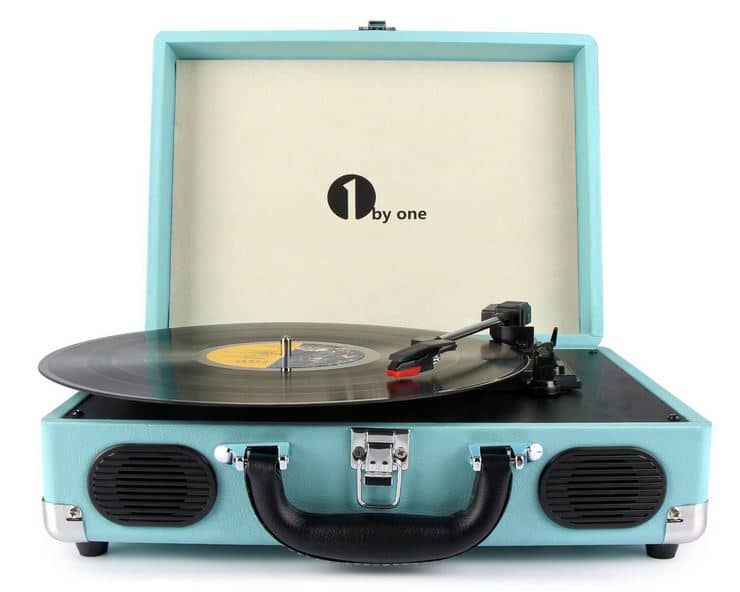
- All-in-one record player with built-in speakers.
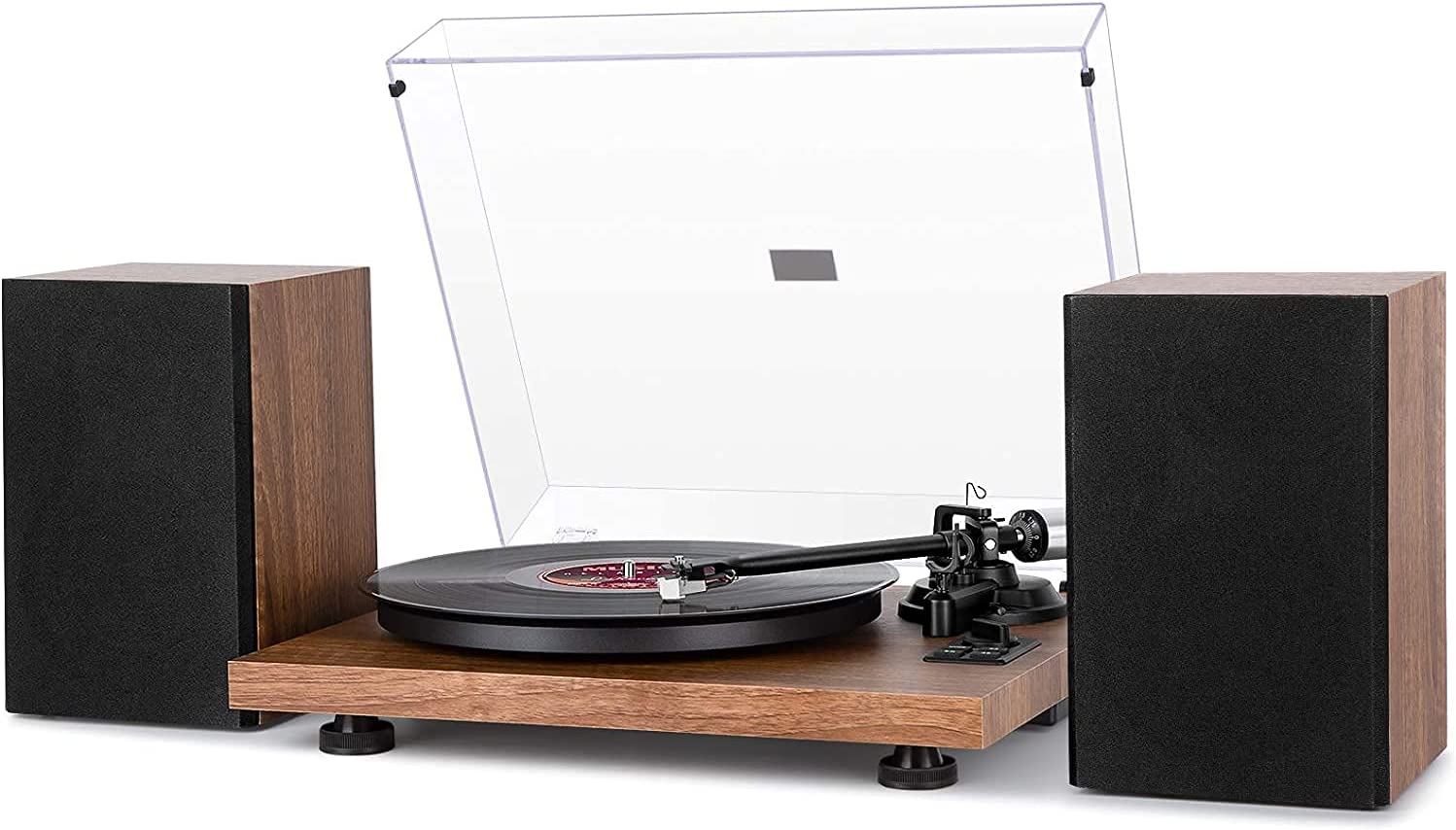
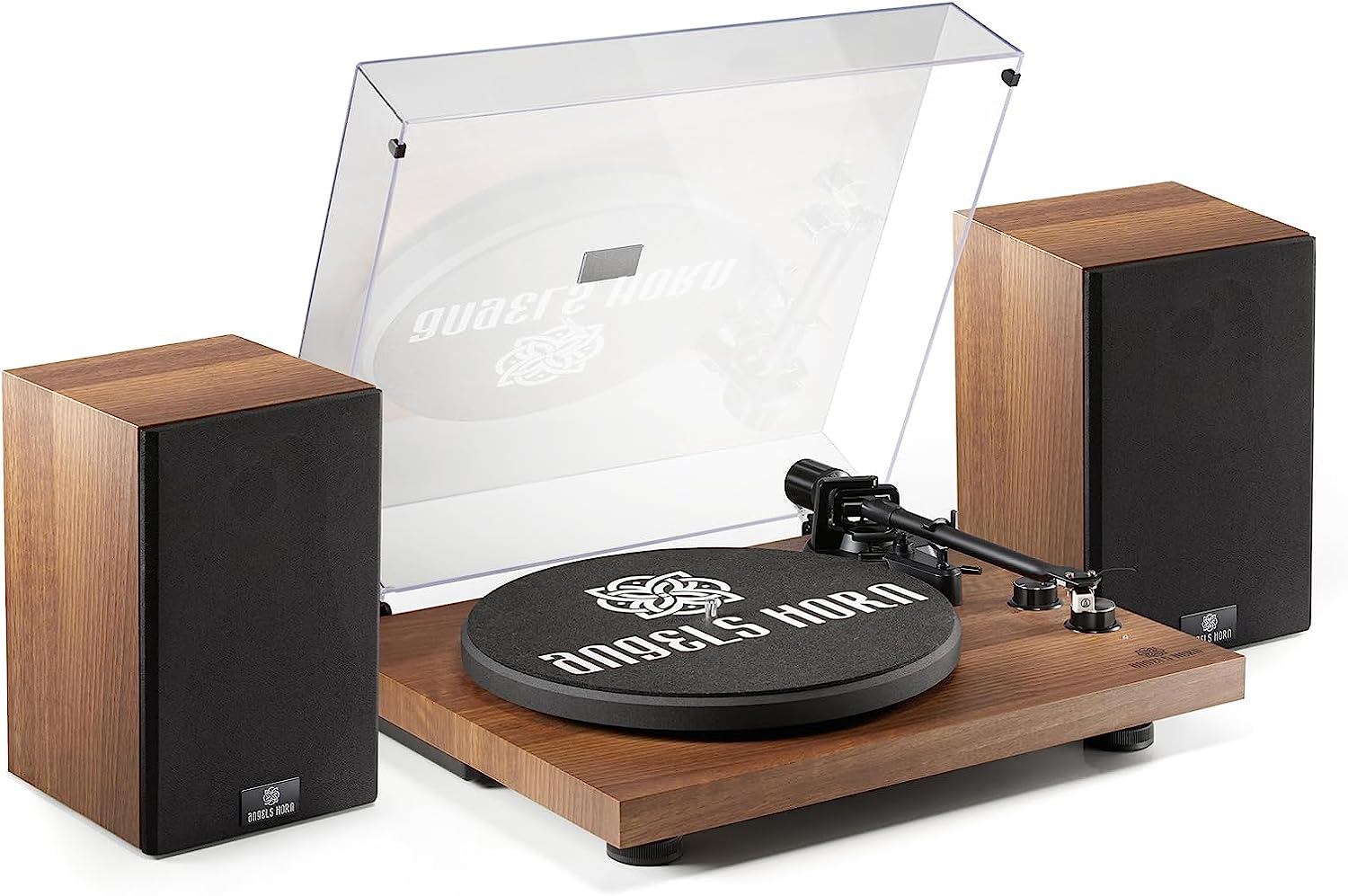
- Turntable with powered speakers.
- Turntable into an amplifier and passive speakers.
- Bluetooth turntable into wireless speakers or headphones.
- USB turntable for digitising records.
An all-in-one unit is the simplest and often the smallest. It can suit occasional listening, bedrooms, student rooms or decorative use. The trade-off is that built-in speakers are usually limited by size, cabinet vibration and placement.
A turntable with powered speakers is often the sweet spot for new listeners. Powered speakers have amplification built in, so you do not need a separate amplifier. Some models also include Bluetooth and extra inputs, which makes them useful beyond vinyl.
A traditional hi-fi setup with an amplifier and passive speakers gives the most flexibility. It can sound excellent, but it also requires more decisions. You must check whether the amplifier has a phono input or whether you need a separate phono preamp.
Bluetooth can be convenient, especially if you already own wireless speakers. The trade-off is that the analogue signal from the record is converted to digital, compressed or processed depending on the system, then converted back to sound. That does not make Bluetooth useless, but it does mean it is mainly a convenience feature rather than the purest route.
USB turntables are useful if you want to archive records to a computer. If your main aim is everyday listening, USB should be treated as a bonus rather than the deciding feature.
Built-in speakers versus separate speakers
Many first-time buyers are drawn to record players with built-in speakers because they look complete. You take the unit out of the box, plug it in, and play a record without choosing extra equipment.
That convenience is real. The compromise is that speakers work best when they are separated from the turntable and placed properly in the room. When speakers are built into the same cabinet as the platter and tonearm, vibration can travel back into the stylus.
This can reduce clarity and, at higher volumes, may cause feedback or muddiness. Small built-in speakers also struggle to reproduce bass with much authority.
Separate speakers do not have to mean a complicated hi-fi rack. Powered bookshelf speakers can be a neat beginner option. Catalogue examples in the speaker category include Edifier R1280DB Powered Bluetooth Bookshelf Speakers and House of Marley Get Together Duo Bookshelf Speakers, although suitability depends on the inputs you need and the rest of your system.
If you want the simplest possible setup but care about sound, consider a turntable with a built-in phono preamp connected directly to powered speakers. That gives you fewer boxes than a full hi-fi system while avoiding the biggest limitations of built-in speakers.
If you mainly want a decorative unit for casual playback, a retro or all-in-one player may still be acceptable. Just recognise that the charm and convenience are part of what you are buying, not necessarily the strongest sound per pound.
Manual, automatic and semi-automatic operation
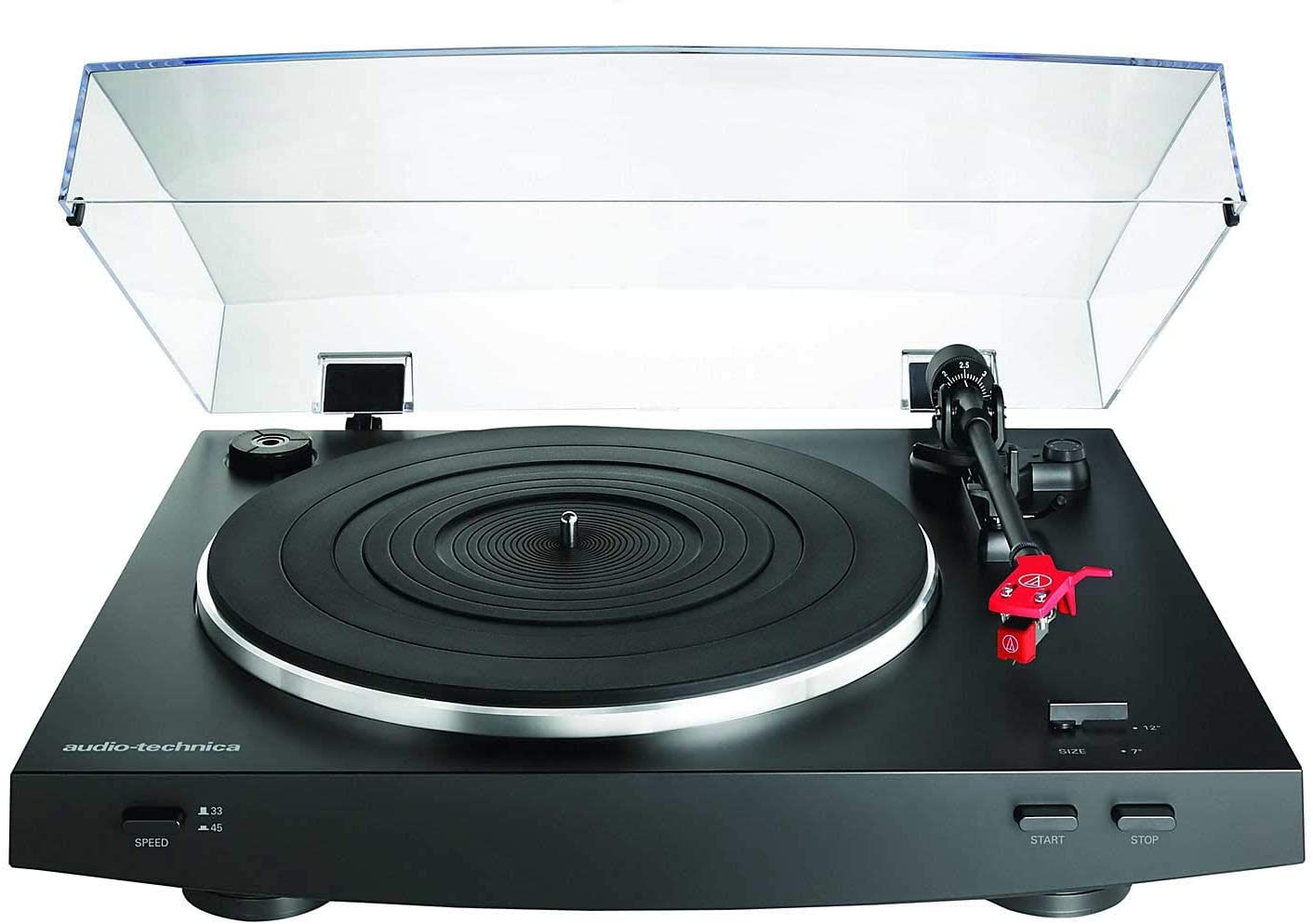
Beginner turntables vary in how much they do for you. A manual turntable requires you to move the tonearm onto the record at the start and lift it at the end. An automatic turntable can start playback and return the arm by itself.
Automatic operation can be reassuring if you are nervous about handling the tonearm. It also reduces the risk of leaving the stylus sitting in the run-out groove for a long time after a side has finished.
Catalogue examples labelled as automatic include the Audio-Technica AT-LP3XBT Automatic Wireless Turntable and the Denon DP-300F Automatic Vinyl Turntable. These names identify them as automatic models in the catalogue, but you should still check the retailer’s current specification before buying.
Manual turntables are not difficult once you learn the basic movement. Many include a cueing lever, which gently lowers the stylus onto the record. This is much safer and steadier than dropping the tonearm by hand.
Semi-automatic designs sit between the two. They may require you to start the record manually but lift or return the arm at the end. This can be a useful compromise, although availability varies by model.
For most beginners, automatic operation is a convenience choice rather than a quality requirement. A well-made manual turntable is perfectly suitable for a first system, provided it has a cueing lever and clear setup instructions.
Understand the cartridge, stylus and tonearm
The cartridge is the small component at the end of the tonearm. It holds the stylus, often called the needle, which sits in the record groove. As the stylus moves, the cartridge turns those tiny movements into an electrical signal.
This part of the system has a large influence on sound. It also affects how safely your records are played. A worn, damaged or badly aligned stylus can cause distortion and may damage grooves over time.
For beginners, the key points are practical:
- Check whether the stylus can be replaced.
- Check whether the cartridge can be upgraded or is fixed permanently.
- Look for a tonearm that allows correct tracking force, or one that is factory-set by a reputable design.
- Avoid using damaged records to judge a new turntable.
Tracking force means the amount of downward pressure the stylus applies to the record. Too little force can make the stylus mistrack, bouncing around the groove. Too much force can increase wear.
Some beginner turntables simplify this by using a pre-set tonearm. Others require you to balance the tonearm and set the tracking force yourself. This is not difficult, but it should be done carefully and according to the cartridge maker’s instructions.
Anti-skate is another adjustment found on many turntables. It applies a small outward force to balance the tonearm’s natural pull towards the centre of the record. Correct anti-skate helps both groove walls play evenly.
Do not panic if these terms are new. The main lesson is that the tonearm and cartridge are not decorative details. They are the parts that physically touch and read your records, so they deserve more attention than colour, lights or novelty features.
Phono preamps and connections explained
A turntable does not usually produce the same kind of signal as a phone, CD player or streamer. Most cartridges produce a very small signal that also needs special equalisation. A phono preamp, sometimes called a phono stage, boosts and corrects that signal so normal audio equipment can use it.
Some turntables have a phono preamp built in. Some amplifiers and powered speakers have a phono input built in. If neither part of your system has one, you will need a separate phono preamp.
This is one of the easiest areas for beginners to get wrong. A turntable plugged into a normal line input without a phono stage will sound extremely quiet and thin. A turntable with its built-in preamp switched on and then connected to a phono input may sound overloaded or distorted.
Look for connection labels carefully:
- “Phono” usually means the input expects a raw turntable signal.
- “Line”, “AUX” or “CD” usually means the signal must already be boosted.
- A switch marked “phono/line” on a turntable usually controls its built-in preamp.
Powered speakers usually need a line-level signal unless they specifically include a phono input. If your chosen turntable has a built-in preamp, connection is much easier. If it does not, add the cost and space of an external phono stage to your plan.
Also check the physical outputs. Many turntables use RCA sockets or attached RCA cables. Some include USB for computer recording.
Bluetooth models may transmit wirelessly, but often still include wired outputs for better flexibility.
Belt drive, direct drive and speed stability
Turntables need to rotate at a steady speed. Most LPs play at 33⅓ rpm, while many singles play at 45 rpm. Some older or specialist records may use 78 rpm, but that is not essential for most modern beginners.
Belt drive turntables use a rubber belt between the motor and platter. This can help isolate motor vibration. Belts can wear over time, but replacement is usually straightforward on many designs.
Direct drive turntables have the platter driven directly by the motor. This design is common in DJ-style turntables because it can start quickly and hold speed firmly. It can also suit home listening when well implemented.
Neither drive type is automatically best for every beginner. A well-designed belt drive can outperform a poor direct drive, and the reverse is also true. Focus on overall build, speed consistency and practical features rather than the label alone.
Speed control matters more than many new buyers expect. If a turntable runs slightly fast or slow, music can sound subtly wrong. If the speed wavers, sustained piano notes, vocals or strings may sound unstable.
Some models offer electronic speed switching, while others require moving the belt by hand to change between 33⅓ and 45 rpm. Manual belt changing is not a disaster, but it is less convenient if you play lots of singles.
The platter also matters. A heavier, well-supported platter can help smooth rotation, although weight alone does not guarantee quality. The mat, bearing and motor control all contribute to how quietly and steadily records spin.
Bluetooth, USB and other convenience features
Beginner turntables often advertise Bluetooth, USB, built-in speakers, radio, CD, cassette, remote controls or retro styling. Some of these features are genuinely useful, but each one should be judged against your actual listening habits.
Bluetooth is helpful if you want fewer cables or already own a wireless speaker. Catalogue examples in Bluetooth categories include the 1 BY ONE Bluetooth Record Player, Audio-Technica AT-LP70XBT Record Player, House of Marley Revolution Wireless Turntable and ION Audio Premier LP Vinyl Turntable. These are examples of models listed in relevant categories, not recommendations.
The limitation is that Bluetooth adds conversion and possible delay. It is usually fine for relaxed listening, but wired connections are generally preferable if sound quality is your main priority.
USB is useful for recording vinyl to a computer. Catalogue examples in USB categories include the Audio-Technica AT-LP120USBHCBK USB Vinyl Turntable, Denon DP-200 USB Vinyl Turntable, ION Audio Air LP Wood Vinyl Turntable and Lenco L3808 Record Player. Before buying for digitising, check what software and output format you will use.
Portable turntables can be fun and convenient, but portability often involves compromises in speaker size, stability and tonearm design. If you plan to build a record collection, be especially careful with any portable unit that has limited tracking adjustment or an unknown stylus type.
Retro styling is a matter of taste. A vintage-looking cabinet can be attractive, but do not assume it reflects old-fashioned build quality. Judge the playback parts as you would on any other turntable.
How to compare beginner turntables without getting lost
A useful comparison starts with needs, not brands. Write down where you will listen, how much space you have, whether you already own speakers, and whether you care more about convenience or future upgrades.
Then compare each option using the same questions:
- Does it need external speakers, and do I have suitable ones?
- Does it include a phono preamp, or will I need one elsewhere?
- Is the stylus replaceable?
- Can the cartridge be upgraded later?
- Is the tonearm automatic, manual or semi-automatic?
- How does it change speed between 33⅓ and 45 rpm?
- Are Bluetooth or USB features essential, or just nice to have?
- Is the design likely to be stable on my furniture?
Do not compare only by feature count. A model with fewer extras may be the better beginner choice if the arm, cartridge and connections are more sensible. Equally, an automatic Bluetooth model may be the right choice if it removes barriers that would stop you using vinyl regularly.
Use catalogue categories as a starting point rather than a ranking. For example, Audio-Technica AT-LP5x Record Player, Fluance RT81 Record Player, Lenco LBT-188 Turntable and House of Marley Stir It Up Vinyl Turntable appear in turntable-related categories, but the right choice depends on system matching and current specifications.
If possible, check the manufacturer’s manual before buying. A clear manual often reveals whether setup is simple, whether the tracking force is adjustable, and what accessories are supplied. It can also show whether the turntable expects a phono input or offers line output.
Setup checklist for your first turntable
Even a good beginner turntable can sound poor if it is set up badly. The aim is to give the stylus a clean, stable path through the groove.
Use this basic setup routine:
- Place the turntable on a level, sturdy surface away from speaker vibration.
- Fit the platter, belt and mat exactly as the manual describes.
- If required, balance the tonearm and set the tracking force.
- Set anti-skate if the turntable provides an adjustment.
- Connect the turntable to the correct phono or line input.
- Keep speakers on a separate surface if possible, not directly beside the platter.
- Clean the record lightly before playing.
- Lower the stylus using the cueing lever rather than your fingers.
A small spirit level can help if your furniture is uneven. A record brush and stylus brush are also sensible early accessories. They are not glamorous, but they solve many noise problems before they become mysteries.
Keep the dust cover closed when the turntable is not in use, but experiment during playback. Some covers can resonate when open or closed, depending on the room and volume. If you hear booming or feedback, try lowering the volume, moving the speakers, or playing with the cover removed if the design allows it.
Never drag the stylus sideways across a record. If you miss the start of the side, lift the arm and try again. Good habits matter more than expensive accessories at the beginning.
Budget priorities and upgrade path
Beginner buyers often ask how much they should spend, but there is no single correct figure. The better question is how to divide your budget across the whole system.
If you do not already own speakers, do not spend everything on the turntable. Speakers shape much of what you hear, and poor speakers can make a decent turntable sound small or harsh. A balanced system is usually more satisfying than one strong component surrounded by weak ones.
Prioritise these areas first:
- A turntable that handles records safely.
- Speakers that suit your room.
- Correct phono or line-level connection.
- A clean, unworn stylus.
- A stable place to put everything.
Upgrades can come later. Common first upgrades include a better stylus, improved speakers, an external phono preamp, a sturdier support, or a more capable cartridge if the tonearm allows it.
Do not rush into upgrades before learning your system. Spend time listening to clean records you know well. If you hear a clear limitation, such as weak bass, noisy playback or poor tracking, then investigate that problem specifically.
A good beginner setup should encourage you to play records often. If it becomes a complicated project before you have enjoyed the music, you may have overbought or chosen the wrong style of system.
At a glance comparison
| All-in-one record player | Simplest and neatest option, but built-in speakers and limited upgrade paths can restrict sound quality. |
|---|---|
| Turntable with powered speakers | A strong beginner balance: fewer boxes than a hi-fi system, better speaker placement, and good everyday usability. |
| Turntable with amplifier and passive speakers | Most flexible route, but requires more matching and may need a phono input or separate phono preamp. |
| Bluetooth turntable | Useful for wireless convenience, though usually not the best choice if maximum sound quality is the priority. |
| USB turntable | Best for digitising records; less important if you only want to listen through speakers. |
| Automatic turntable | Beginner-friendly operation and arm return, but quality still depends on the wider design, not automation alone. |
Frequently asked questions
Is a cheap suitcase record player good enough to start with?
It can be enough for very casual listening, especially if convenience and appearance matter most. However, many suitcase-style players have small speakers and limited adjustment, so they are not usually the best foundation for a growing record collection.
If you plan to buy records regularly, look for a turntable with a replaceable stylus, stable playback and the option to use separate speakers.
Do I need an amplifier for my first turntable?
Not always. You need amplification somewhere in the system, but it may be built into powered speakers or an all-in-one record player.
If you use passive speakers, you need an amplifier. If your turntable does not have a built-in phono preamp and your amplifier lacks a phono input, you will also need a separate phono stage.
Will Bluetooth speakers work with vinyl?
Yes, if the turntable can transmit Bluetooth to your speaker, or if you use another compatible Bluetooth device in the chain. It is a convenient way to listen with fewer cables.
The trade-off is that the analogue signal is converted for wireless transmission. For the best sound and lowest fuss, a wired connection to suitable speakers is often preferable.
Should a beginner choose belt drive or direct drive?
Either can work well. Belt drive is common in home listening turntables and can help isolate motor vibration. Direct drive is common in DJ-style designs and can offer quick start-up and strong speed control.
For beginners, the overall design matters more than the drive label. Look at setup, tonearm quality, speed stability and connection options.
How often should I replace the stylus?
There is no universal answer because stylus life depends on the stylus type, record condition, tracking force and how often you play records. Follow the cartridge or turntable manufacturer’s guidance where available.
Replace the stylus if you hear persistent distortion, mistracking or excessive sibilance after cleaning records and checking setup. Do not keep playing records with a visibly damaged stylus.
Can I plug a turntable straight into a soundbar?
Sometimes, but only if the connections match. Many soundbars have digital inputs or Bluetooth rather than analogue RCA inputs. A turntable with line output may connect to a soundbar with a suitable analogue input, but a phono-only turntable will need a phono preamp first.
Soundbars are designed mainly for television sound, so stereo music placement may be less convincing than with separate speakers.
Are vintage turntables better for beginners?
A well-serviced vintage turntable can be excellent, but it is not always the easiest first purchase. Older units may need a new belt, cartridge, stylus, cables or professional adjustment.
If you enjoy maintenance and can verify condition, vintage can be rewarding. If you want predictable setup and support, a current beginner-friendly model may be simpler.
What accessories should I buy with my first turntable?
Start with useful basics rather than expensive tweaks. A carbon fibre record brush, stylus brush and a safe way to store records upright are sensible.
If your turntable requires manual setup, a tracking force gauge can also help. Record cleaning becomes more important as your collection grows, especially if you buy second-hand vinyl.
Final thoughts
The best beginner turntable is the one that fits your room, your speakers, your confidence level and your long-term interest in vinyl. Do not be distracted by every feature on the box. Focus first on safe playback, clear connections, stable speed and speakers that let the record breathe.
If you want the simplest path, consider an all-in-one player while accepting its limits. If you want a better balance of convenience and sound, a turntable with a built-in phono preamp and powered speakers is often a sensible starting point. If you already own hi-fi equipment, check phono compatibility before spending anything.
Your next step is to map your system: turntable, phono stage if needed, amplifier if needed, and speakers. After that, read more deeply about phono preamps, cartridge types and speaker matching, because those three areas will help you make the most confident first purchase.