Quick answer
The best Bluetooth record player for most buyers is one that transmits vinyl audio to your chosen Bluetooth speaker or headphones, has a proper tonearm and cartridge arrangement, and still gives you a wired output for future upgrades. Wireless convenience is helpful, but it should not replace the basics of stable speed, safe tracking and decent speakers.
If you want the simplest set-up, consider an automatic Bluetooth turntable or a package with powered speakers. If you care more about long-term sound quality, choose a separate turntable with Bluetooth as an extra feature, not as the whole reason to buy it.
In this guide
- What Bluetooth can and cannot do for vinyl playback
- The difference between Bluetooth transmitters, receivers and all-in-one systems
- Why speaker choice often matters more than the Bluetooth feature itself
- Which turntable basics still count: cartridge, tracking, platter and outputs
- How to avoid common buying mistakes with wireless record players
- When a wired turntable may be the better choice despite the convenience of Bluetooth
Watch the article video
What makes a Bluetooth record player different?
A traditional turntable sends a small electrical signal through a cable to an amplifier, phono stage, powered speakers or hi-fi system. A Bluetooth record player adds wireless audio in some form, usually so the sound can be sent to a Bluetooth speaker, soundbar or headphones.
The important word is “some”. Bluetooth is not always used in the same direction. A turntable may transmit vinyl to a speaker, receive music from your phone for playback through built-in speakers, or do both.
For vinyl listeners, Bluetooth transmission is usually the feature people are looking for. This lets the record player send the music from the record to a wireless speaker or headphones.
Bluetooth reception is different. It means the record player acts more like a speaker system for your phone, tablet or laptop. That can be useful, but it does not help you play records wirelessly to another speaker.
When comparing products, look for clear wording such as “Bluetooth output”, “Bluetooth transmitter” or “wireless output”. Phrases such as “Bluetooth enabled” or “Bluetooth connectivity” are not always precise enough.
The main types of Bluetooth record player
Bluetooth record players usually fall into a few broad groups. Understanding the type helps you compare fairly, because a portable briefcase player and a separate hi-fi turntable are built for different priorities.
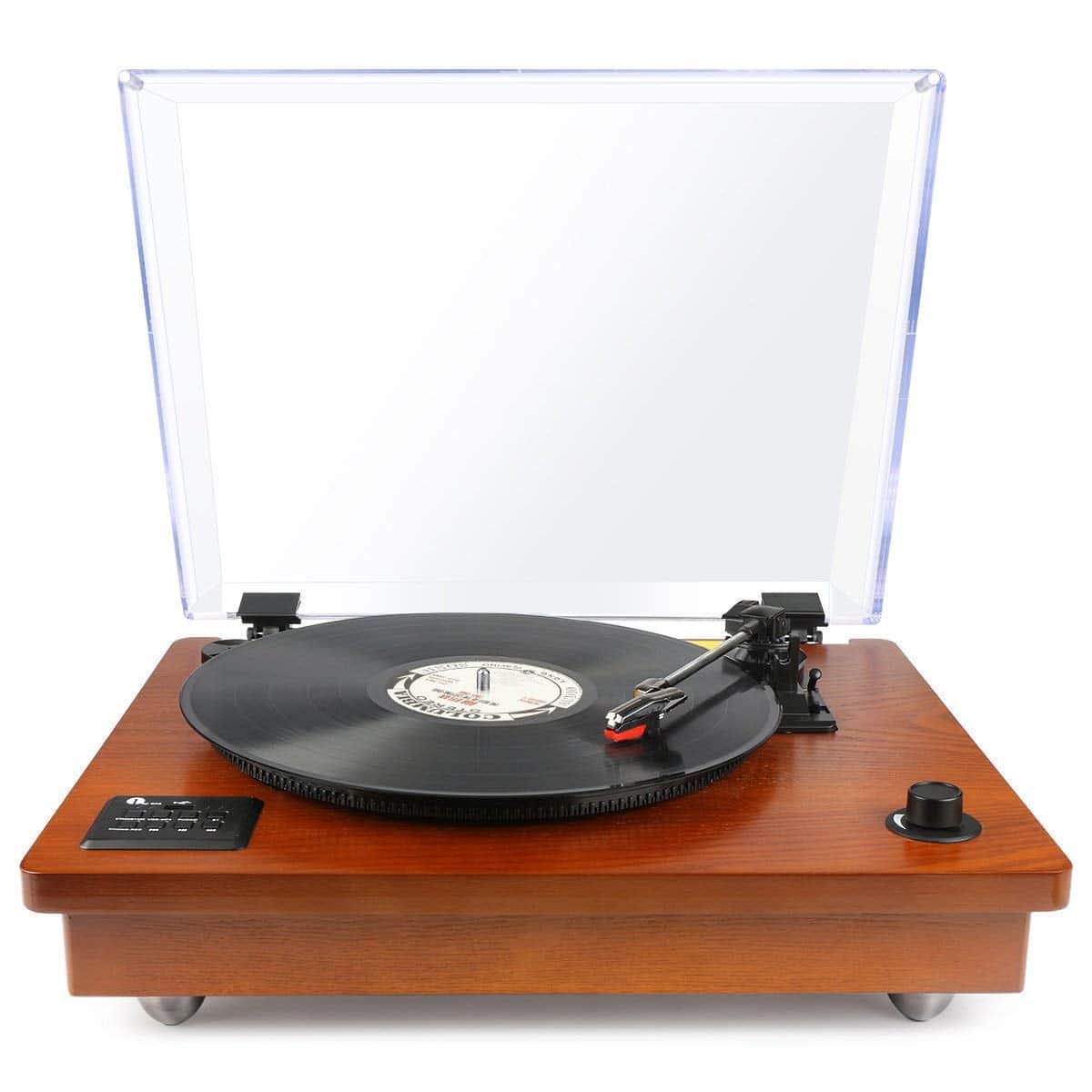
- Separate Bluetooth turntables: These are turntables designed to connect to external speakers, either wirelessly or by cable. Catalogue examples include the Audio-Technica AT-LP60XBT Turntable, Audio-Technica AT-LP70XBT Record Player, Audio-Technica AT-LP3XBT Automatic Wireless Turntable, House of Marley Revolution Wireless Turntable and Lenco LBT-188 Turntable.
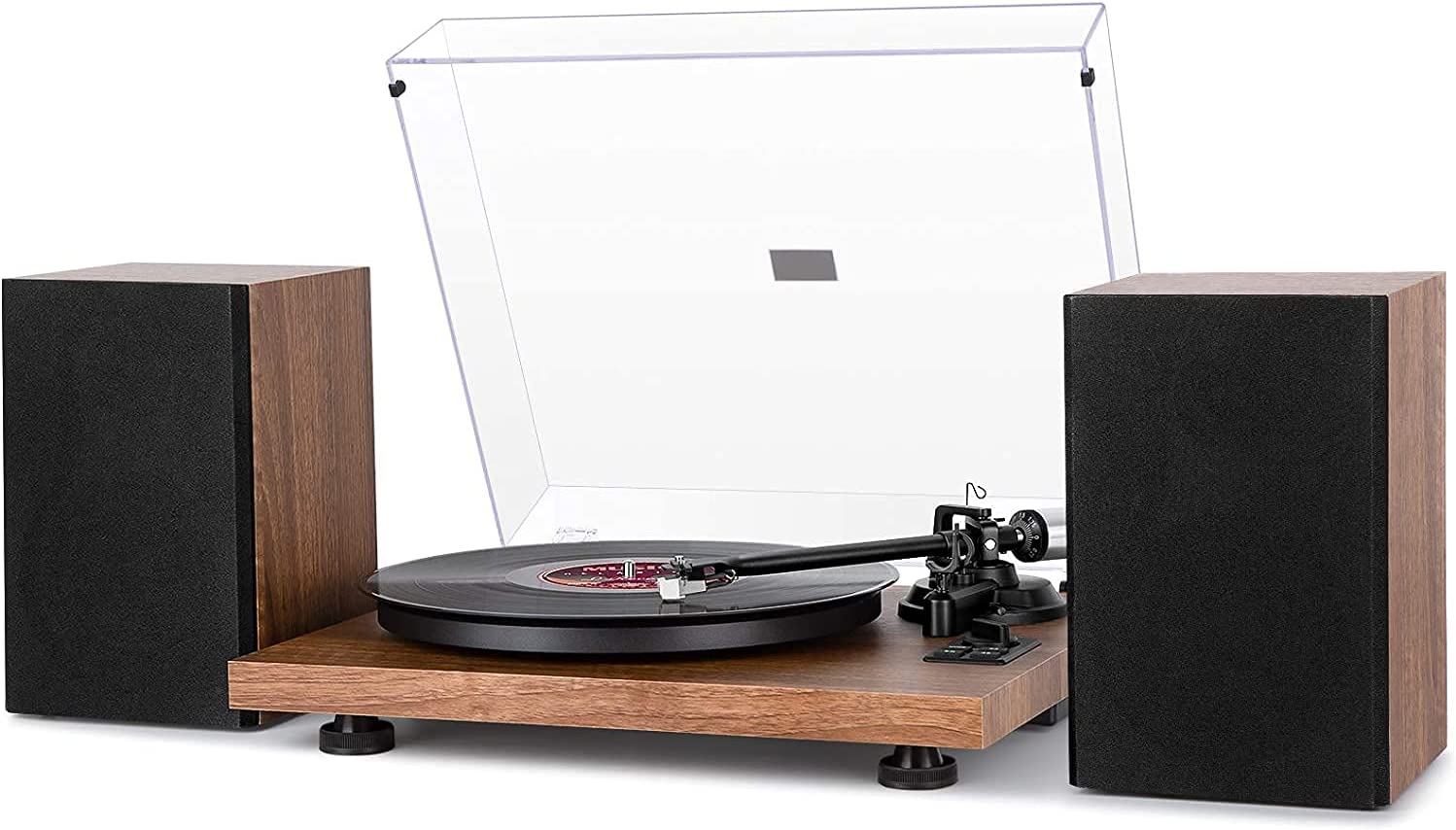
- Packages with speakers: These include a turntable and matching or bundled speakers. Catalogue examples include the Crosley C62 Bluetooth Record Player With Speakers, Lenco LS-300 Bluetooth Record Player and Majority Moto Plus Bluetooth Record Player With Speakers.
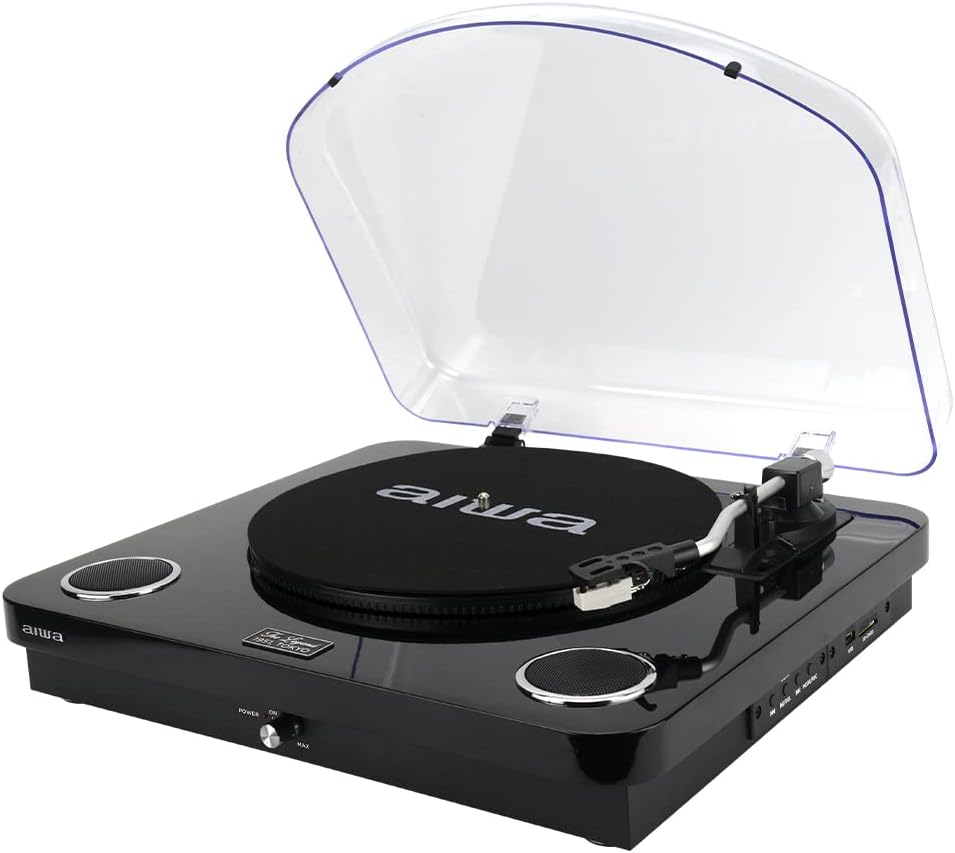
- All-in-one Bluetooth record players: These put the turntable, amplifier and speakers in one unit. They may also include radio, CD, cassette or USB functions. Catalogue examples include the Auna Oakland DAB Retro Record Player, Mersoco 10-in-1 Bluetooth Record Player and Denver MCR-50 8-in-1 Retro Record Player.
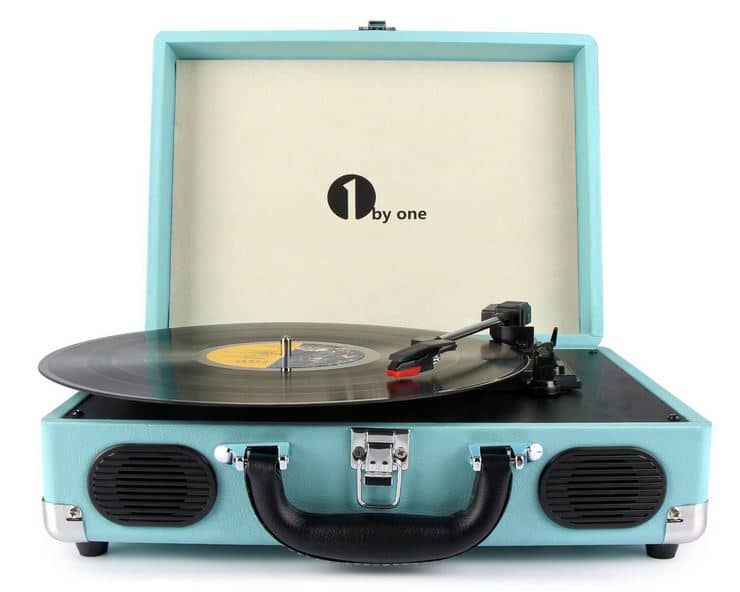
- Portable Bluetooth players: These are designed for easy movement or compact spaces. Catalogue examples include the Audio-Technica SB727 Sound Burger Portable Bluetooth Turntable, Akai A60011NR Bluetooth Rechargeable Vinyl Turntable and Fenton RP118B Briefcase Record Player.
None of these categories is automatically best. The right choice depends on whether you want convenience, sound quality, portability, a tidy living room set-up or an upgrade path.
Sound quality: the main Bluetooth trade-off
Bluetooth is convenient, but it is not the purest way to listen to records. Vinyl audio has to be converted into a digital signal, compressed, transmitted wirelessly, received, and then converted back into sound by the speaker or headphones.
That process can still sound enjoyable, especially for casual listening. However, a good wired connection can usually preserve more detail and avoid wireless connection issues.
Bluetooth quality also depends on the speaker or headphones. A modest turntable feeding a good speaker may sound more satisfying than a better turntable feeding a weak compact speaker. Many disappointing vinyl set-ups are held back by the speakers rather than the record player.
Do not assume that “Bluetooth” means high fidelity. It is a convenience feature first. If sound quality is your top priority, make sure the turntable has wired outputs as well, so you can connect it to powered speakers, an amplifier or a phono stage later.
Also consider latency. Bluetooth can introduce a small delay, which is not normally a problem when listening to records, but it can be annoying if you are trying to watch a video while using the same speaker or headphones.
Check whether Bluetooth sends or receives audio
This is the most important specification to check before buying. Many buyers expect a Bluetooth record player to send vinyl to wireless speakers, then discover the Bluetooth function only plays music from a phone through the record player’s own speakers.
Use this simple check:
- Look for the words “Bluetooth output”, “Bluetooth transmitter” or “connects to Bluetooth speakers/headphones”.
- If the product only says “stream music from your phone”, it is probably a Bluetooth receiver rather than a transmitter.
- Check whether it can pair with headphones if that is your main use.
- If you already own a Bluetooth speaker, confirm that the turntable can send audio to an external Bluetooth device.
- If the wording is unclear, treat it as a warning sign rather than a small detail.
Some models may include both transmission and reception, but you should not assume this. Direction matters more than the presence of the Bluetooth logo.
Built-in speakers versus separate speakers
Many Bluetooth record players include built-in speakers. This is convenient, but it is also one of the biggest compromises in record player design.
A turntable needs to keep the stylus steady in the groove. Speakers create vibration. Placing speakers in the same cabinet as the turntable can make vibration control harder, especially at higher volume.
Built-in speakers also tend to be small because they must fit inside the record player body. Small speakers can be fine for background listening, but they usually struggle with bass, stereo separation and room-filling sound.
Separate speakers give you more flexibility. Powered Bluetooth speakers, such as the Edifier R1280DB Powered Bluetooth Bookshelf Speakers or House of Marley Get Together Duo Bookshelf Speakers in the local catalogue, can be used with compatible sources and placed away from the turntable. Placement alone can make a noticeable difference.
If you want the neatest possible system, an all-in-one player can be acceptable for casual use. If you plan to listen regularly and buy records you care about, a separate speaker arrangement is usually the safer long-term choice.
Turntable basics still matter
Wireless features do not excuse poor mechanical design. A record player still has to spin at the correct speed, hold the record steadily and guide the stylus through the groove without excessive force.
Look at the cartridge first. The cartridge is the small component at the end of the tonearm that holds the stylus and turns groove movement into an electrical signal. A replaceable cartridge or at least a replaceable stylus is important because styli wear out.
The tonearm matters too. It should lower smoothly, track the record reliably and avoid dragging across the groove. Some beginner models are automatic, meaning the arm starts and returns by itself, which can help new users avoid handling mistakes.
Tracking force is the pressure the stylus applies to the record. Too little can cause skipping; too much can increase wear. Some turntables set this automatically, while others allow adjustment.
Also check the platter and speed options. Most modern LPs play at 33⅓ rpm, most singles at 45 rpm, and some older records at 78 rpm. Do not pay extra for 78 rpm unless you know you need it, because true 78 playback often also requires a suitable stylus.
A Bluetooth record player should still be judged as a turntable first. The wireless feature is only useful if the record itself is being played safely and consistently.
Manual, automatic and portable choices
Bluetooth record players can be manual, automatic or portable. Each style suits a different listener.
A manual turntable requires you to place the tonearm on the record and lift it at the end. This gives you control and is common on many traditional turntables, but it demands a little care.
An automatic turntable starts playback at the press of a button and may return the arm at the end. This is helpful if you are new to vinyl, have limited dexterity, or simply want fewer handling steps. Catalogue examples in the automatic wireless area include the Audio-Technica AT-LP3XBT Automatic Wireless Turntable.
Portable models focus on compactness and easy storage. They can be useful for occasional listening or small rooms, but portability often means compromises in platter size, speaker size, tonearm design or upgrade options. The Audio-Technica SB727 Sound Burger Portable Bluetooth Turntable is one example of a portable Bluetooth turntable in the local catalogue.
Think about how you will actually use the player. If it will live permanently on a shelf and be used several times a week, stability and speaker quality should matter more than portability. If it will be moved between rooms, compactness and simple pairing may matter more.
Outputs and upgrade paths
A good Bluetooth record player should not lock you into Bluetooth forever. Wired outputs make the product more useful as your system changes.
The most common outputs are phono-level and line-level. A phono-level signal is very quiet and needs a phono stage, which is a circuit that boosts and equalises the signal correctly for vinyl. A line-level output has already passed through a built-in phono stage and can connect to many powered speakers or amplifier inputs.
Some turntables have a switch that lets you choose between phono and line output. This is useful because it allows you to start simply and later add a better external phono stage or amplifier.
USB is another feature on some record players. It is mainly for recording vinyl to a computer, not for connecting to Bluetooth speakers. Do not confuse USB and Bluetooth; they solve different problems.
Before buying, ask yourself:
- Can I use this with my current speaker or headphones?
- Can I connect it by cable if Bluetooth pairing is unreliable?
- Can I upgrade the speakers later?
- Can I replace the stylus when it wears out?
- Am I paying for extra features I will never use?
A flexible output section often matters more than a long list of lifestyle features.
How to choose for different rooms and listening habits
For a bedroom or home office, a compact Bluetooth turntable and powered speaker can work well. The main aim is convenience, low clutter and easy volume control. Keep the turntable on a stable surface, away from the speaker if possible.
For a living room, think more carefully about speaker placement. Two separate speakers placed apart will usually give a wider stereo image than a single wireless speaker. If your Bluetooth speaker is mono or very compact, it may limit the experience.
For headphone listening, make sure the turntable can transmit to Bluetooth headphones. Also check how easy pairing is likely to be in a household with many Bluetooth devices. Some systems remember previous connections; others need manual pairing more often.
For shared flats or student rooms, avoid judging only by loudness. A turntable with sensible tracking, replaceable stylus and a headphone option may be more useful than a very loud all-in-one unit.
For occasional nostalgia listening, an all-in-one retro player may be enough. For building a record collection, choose something with better core turntable features and separate speakers.
A practical buying checklist
Use this checklist before choosing a Bluetooth record player. It helps separate useful features from marketing noise.
- Decide your main use: speakers, headphones, portability, background listening or a proper hi-fi set-up.
- Confirm Bluetooth direction: transmission for wireless speakers/headphones, reception for playing phone audio through the unit.
- Check wired outputs: line output is useful for powered speakers; phono output is useful for hi-fi upgrading.
- Look for a replaceable stylus: this is essential for maintenance.
- Consider speaker arrangement: separate speakers are usually better than built-in speakers for regular listening.
- Check operation style: manual, automatic or portable.
- Avoid paying for unused features: radio, CD, cassette and USB may be helpful, but only if you will use them.
- Plan the placement: the turntable needs a level, stable surface away from strong vibration.
- Check record speeds: 33⅓ and 45 rpm cover most modern collections.
- Read the product wording carefully: vague Bluetooth descriptions can hide important limitations.
If two products seem similar, choose the one with clearer outputs, safer record handling and easier stylus replacement. Those features will matter long after the novelty of wireless pairing has worn off.
At a glance comparison
| Bluetooth separate turntable | Best for buyers who want wireless convenience but may upgrade later. Look for wired outputs, replaceable stylus and clear Bluetooth transmission. |
|---|---|
| Turntable with bundled speakers | Good for simple first systems. Compare speaker placement options and whether the turntable can be used with other speakers later. |
| All-in-one Bluetooth record player | Convenient and compact, often with extra features. Usually the biggest compromise for sound quality, vibration control and upgrade flexibility. |
| Portable Bluetooth turntable | Useful for small spaces and occasional movement. Check stability, power options, stylus replacement and whether portability has reduced core turntable quality. |
| Traditional wired turntable | Not wireless, but often better value for sound quality if you already have speakers or an amplifier. Bluetooth can be added elsewhere in some systems. |
Frequently asked questions
Can I connect a Bluetooth record player to any Bluetooth speaker?
Usually, but not always. The record player must be able to transmit Bluetooth audio, and the speaker must be able to receive it. Pairing can vary between devices, so check the product wording and keep a wired backup if reliable daily use matters.
Will Bluetooth ruin the sound of vinyl?
It will not ruin it for casual listening, but it does add digital conversion and wireless compression. Many people still enjoy the result, especially with decent speakers. For the best sound quality, a wired connection remains the safer choice.
Do Bluetooth record players need an amplifier?
It depends on the design. Some have built-in speakers, some connect to powered speakers, and some can connect to an amplifier. If using passive speakers, you will still need an amplifier between the turntable and the speakers.
Can I use Bluetooth headphones with a record player?
Yes, if the record player has Bluetooth transmission and supports pairing with headphones. Do not assume this from the word Bluetooth alone. Some models only receive Bluetooth from phones and cannot send vinyl to headphones.
Are suitcase Bluetooth record players bad for records?
Not all suitcase-style players are identical, but many prioritise portability and appearance over tonearm quality, vibration control and speaker performance. If you will play valuable records often, look carefully at stylus replacement, tracking behaviour and the availability of wired outputs.
What is a built-in phono stage and why does it matter?
A phono stage boosts the tiny signal from the cartridge and applies the correct equalisation for records. A built-in phono stage lets you connect more easily to powered speakers or line inputs. A switchable phono stage gives more flexibility for future upgrades.
Is an automatic Bluetooth turntable better for beginners?
It can be. Automatic operation reduces the need to cue the tonearm by hand, which may help prevent accidental drops or scratches. However, automatic operation should still be paired with good basic turntable design and a replaceable stylus.
Should I buy Bluetooth speakers or a Bluetooth record player first?
If you already own good Bluetooth speakers, choose a turntable that clearly transmits audio. If you are starting from nothing, consider the whole system together. A modest turntable with suitable speakers may be more satisfying than a feature-packed player with weak built-in sound.
Final thoughts
The best Bluetooth record player is not simply the one with the longest feature list. It is the one that matches how you want to listen while still treating your records properly.
For most buyers, the safest route is a Bluetooth turntable with clear wireless transmission, wired outputs, a replaceable stylus and separate speakers. If you need maximum simplicity, a bundled speaker package or all-in-one unit may suit, but understand the limits before buying.
Your next step is to decide whether you need Bluetooth output to speakers or headphones, or whether you only want Bluetooth input from a phone. After that, compare turntable fundamentals: stylus, tonearm, outputs, speaker arrangement and upgrade options.
For further reading, move on to guides about powered speakers, phono stages and beginner turntable set-up. Those topics will help you build a system that stays enjoyable after the first wireless pairing is complete.