Introduction
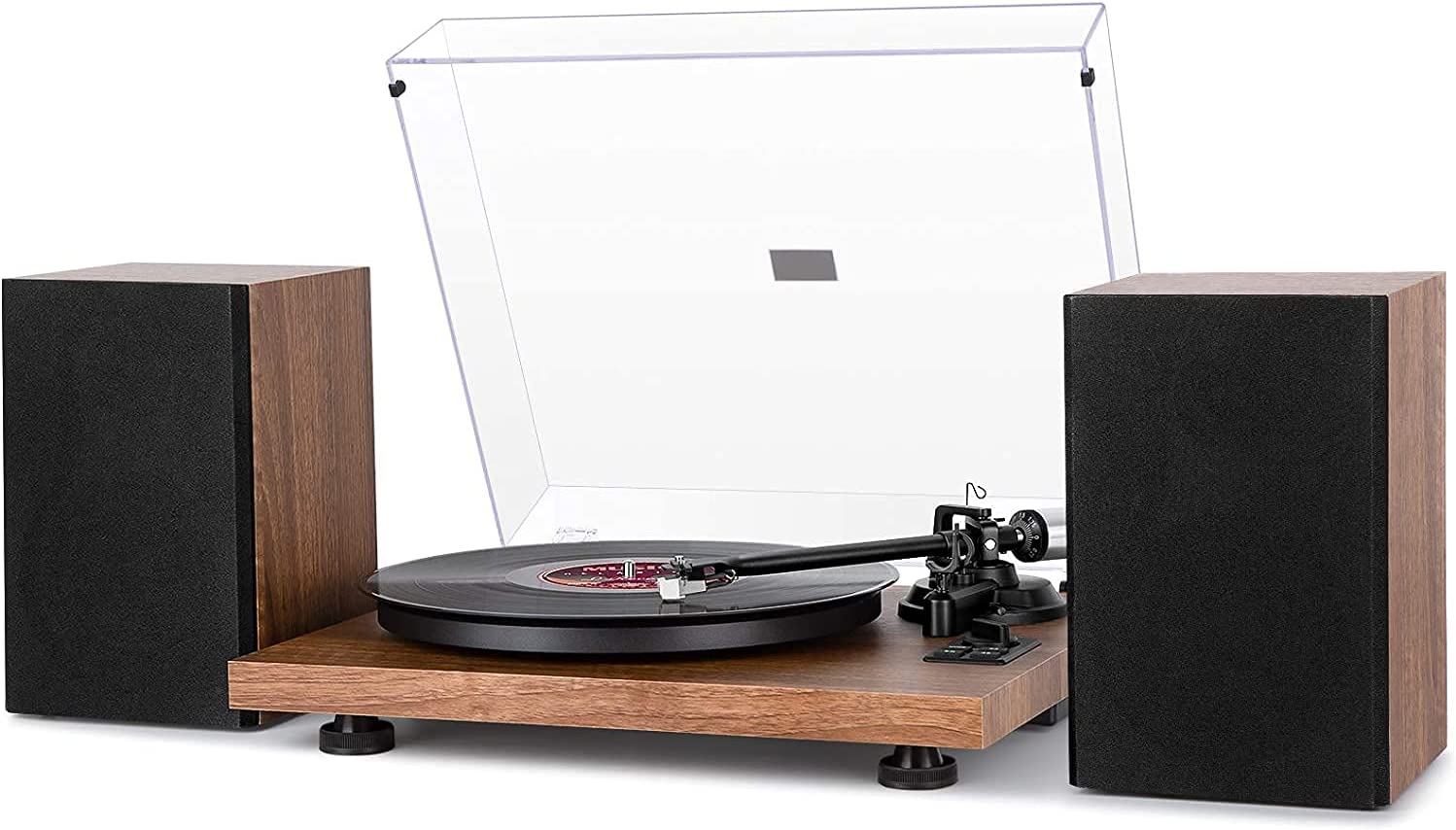
The 1 BY ONE Bluetooth Record Player is a complete turntable system with a manual belt-drive deck and two separate bookshelf speakers. It is aimed at beginners who want to start playing records without choosing a separate amplifier, phono stage and speaker package.
Watch the product video
The version covered here is the H004-style speaker bundle, not the similarly named 1byone H005 standalone Bluetooth turntable. Its appeal is convenience, but it is also more credible than many suitcase-style players because it uses a moving-magnet cartridge, adjustable tracking force and external speakers.
It is best suited to bedrooms, offices and small living spaces where simple vinyl playback, Bluetooth input and USB recording are more important than hi-fi upgrade depth from day one.
Design and build
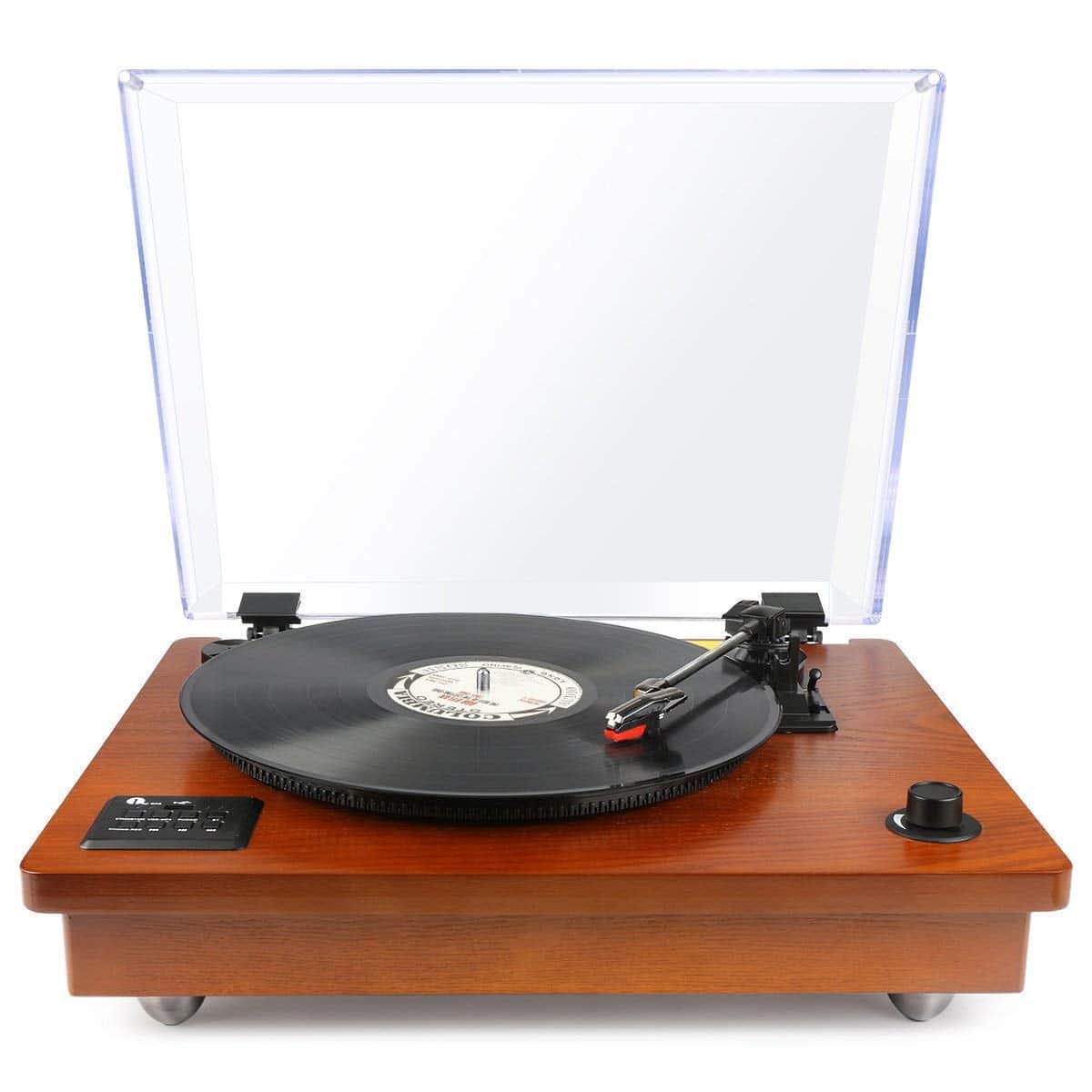
This is a two-speaker hi-fi-style system rather than an all-in-one portable record player. The turntable has a wooden-style plinth, removable dust cover and a belt-driven platter arrangement with a 28 cm iron platter.
The tonearm is a static-balance straight arm with an adjustable counterweight and a separate hanging anti-skating weight. Those parts make it more adjustable than fixed-weight beginner players, although they also add a little setup complexity.
The supplied passive bookshelf speakers connect to terminals on the turntable and are powered by its built-in amplifier. Keeping the speakers separate from the deck is a sensible design choice, but the manufacturer’s setup guidance still points towards using a sturdy, level surface and keeping vibration sources away from the turntable.
Controls are practical rather than fully automated. The user selects the speed, starts or stops playback and cues the arm manually, so it feels closer to a basic component turntable than a push-button automatic deck.
Features
The core feature set is strong for a starter bundle. The supplied Audio-Technica AT3600L moving-magnet cartridge is a replaceable entry-level design, and it is paired with adjustable tracking force and anti-skating rather than a fixed ceramic cartridge.
Connectivity is unusually broad for an all-in-one package. The built-in phono stage has a phono/line switch, allowing the RCA output to feed a phono input, a line input, an amplifier, a receiver or active speakers when set correctly.
Bluetooth is included, but it is Bluetooth input. That means a phone, tablet or computer can stream music through the system’s speakers; it is not documented as a way to send vinyl playback to Bluetooth headphones or wireless speakers.
USB recording is another useful extra. The manual describes a USB PC link for recording records in software such as Audacity, which is convenient for casual digitising rather than a substitute for a dedicated archival transfer setup.
Setup
Setup is more involved than a fully automatic plug-and-play record player. The user needs to fit the belt and platter, install the counterweight, balance the tonearm, set tracking force to 3.5 g, attach the anti-skating weight and connect the supplied speakers.
That process is manageable, but it may be fiddly for complete beginners. Taking time over levelling the deck, speaker placement and the phono/line switch will matter more than it would with a simpler automatic model.
Once assembled, daily use is straightforward but hands-on. You choose the speed, cue the arm, stop playback and return the tonearm yourself after each side.
Performance
Day-to-day use is manual. You select 33 1/3 or 45 rpm, press play/stop, cue the tonearm onto the record and return it at the end of the side; no 78 rpm speed or full automatic tonearm operation is specified.
The belt drive, DC motor and iron platter are intended to provide stable basic playback, and the official specifications list wow and flutter around the 0.15% mark depending on the wording used. At this level, correct setup and a stable support are likely to matter, and owner evidence suggests some variation in setup sensitivity and quality control.
The system is flexible for a first purchase because it can operate with its own speakers or feed external equipment through the RCA outputs. The phono/line switch is important: line is for line-level inputs or active speakers, while phono is for a proper phono input.
There is also standby behaviour after inactivity according to the documentation, although timing differs between official/manual variants. That is not the same as automatic arm return, and reports of standby behaviour during very quiet sections are worth bearing in mind.
Sound quality
Based on the supported design, this should be a more record-friendly and capable starting point than very cheap built-in-speaker players. The moving-magnet cartridge, adjustable counterweight, anti-skating and separate speakers all help its case as a proper beginner system.
The AT3600L is a robust entry-level cartridge with a recommended tracking force of 3.5 g. That is normal for this cartridge, but it points more towards dependable casual playback than fine-detail audiophile performance.
The supplied speakers are convenient and specified at 18 W each, with 4 in woofer and 2 in tweeter drivers per speaker. They are likely to be good enough for small rooms and casual listening, but they are also the most obvious bottleneck if the buyer later wants deeper bass, wider scale or greater refinement.
A useful strength is that the turntable is not locked into the bundled speakers. Using the RCA output with better powered speakers, or feeding a separate amplifier correctly, gives a clear upgrade route without replacing the whole system immediately.
Pros
- Complete turntable-and-speaker bundle for beginners Audio-Technica AT3600L moving-magnet cartridge rather than a fixed ceramic type Adjustable counterweight and anti-skating support more accurate setup Built-in phono stage with switchable phono/line RCA output
- Bluetooth input for streaming phone audio through the speakers USB recording option for casual vinyl digitising Separate speakers give a better layout than built-in-speaker record players
Cons
- Bluetooth is input-only, not wireless vinyl output
- Manual setup can be fiddly for first-time users
- No full automatic tonearm start or return
- Bundled speakers are likely to limit ultimate sound quality
- No 78 rpm speed is specified Owner evidence suggests possible setup sensitivity and quality-control variation
Verdict
The 1 BY ONE Bluetooth Record Player makes most sense as a neat first vinyl system rather than a final hi-fi purchase. Its strongest qualities are the complete speaker bundle, proper moving-magnet cartridge, adjustable arm setup, Bluetooth input, USB recording and switchable phono/line output.
The trade-offs are clear. It is manual, the speakers are likely to be the limiting factor, Bluetooth does not transmit vinyl wirelessly, and beginners must take setup seriously.
For buyers who want a practical, affordable-style route into records with room to upgrade later, the H004 speaker-bundle system is a credible option. Those prioritising automatic operation, wireless headphone playback or higher-grade sound should consider a different turntable and speaker arrangement.