Introduction
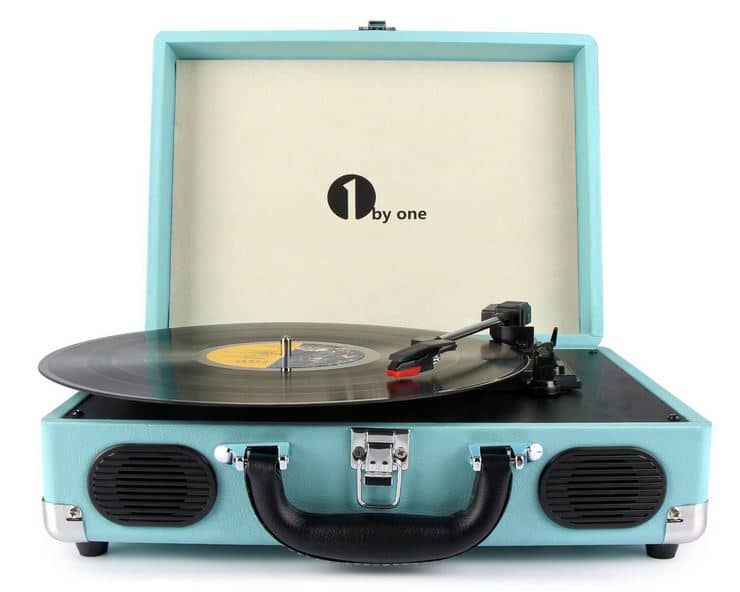
The 1byone Vinyl Turntable is a budget manual record player for buyers who want a separate-speaker deck with modern connection options. It is aimed at people moving beyond suitcase-style record players, rather than those looking for a fully automatic hi-fi component.
Watch the product video
Its appeal is the combination of belt drive, a moving-magnet Audio-Technica AT-3600L cartridge, built-in phono stage, Bluetooth output and USB recording. The model evidence identifies it as 1-AD07US01/H005, which helps distinguish it from other 1byone record players with different layouts or built-in speakers.
This is not an all-in-one system. You will need powered speakers, Bluetooth speakers or headphones, or a separate amplifier/receiver and passive speakers.
Design and build
The 1byone takes a more conventional turntable form than compact portable record players. It uses a separate platter and belt-drive system, with a dust cover, slip mat and manual tonearm arrangement.
The tonearm has an adjustable counterweight and anti-skating weight, which is a useful step up from many very basic players. That extra adjustability also means the deck depends on careful setup rather than simply being lifted from the box and played immediately.
Controls and connections are practical rather than elaborate. The rear panel provides RCA outputs with a PHONO/LINE switch, a ground connection, a USB-PC port and power input, while Bluetooth is used for wireless output to compatible speakers or headphones.
The supplied evidence points to budget construction, so expectations should be realistic. Owner feedback is broadly positive about value and appearance, but recurring comments mention unit-dependent issues such as belt behaviour, speed drift, platter wobble or skipping, often linked to setup or quality-control variation.
Features
The key feature is flexibility. The built-in phono equaliser lets the turntable connect to a line-level input or powered speakers in LINE mode, while PHONO mode can be used with a suitable moving-magnet phono input.
Bluetooth is included, but only as a transmitter. It can send record playback to compatible Bluetooth speakers or headphones, but it cannot receive music from a phone and play it through the turntable.
USB recording is another useful extra at this price level. The USB-PC connection is intended for digitising records on a computer, and the manual describes recording with Audacity without requiring extra drivers.
The deck plays 33 1/3 and 45 RPM records and includes a replaceable Audio-Technica AT-3600L moving-magnet cartridge/stylus. The manual gives a recommended tracking force of 3.5 g, with a tolerance of ±0.5 g for the factory-fitted cartridge.
Setup
Setup requires more care than a plug-and-play automatic turntable. The platter and belt need fitting, the counterweight must be set, and the anti-skating weight has to be arranged correctly before regular use.
The included cartridge alignment protractor, USB-PC cable, 45 RPM adaptor, dust cover, counterweight and anti-skating weight help make the package usable, but they also show that this is a hands-on design. Beginners should follow the manual closely, especially when setting the factory-recommended tracking force.
Once configured, daily operation is straightforward but manual. You select the speed, cue the record, choose the appropriate output route and remember to return the tonearm at the end of playback.
Performance
In day-to-day use, this is a manual turntable. The listener cues the arm, starts playback and returns the arm manually at the end of a side; there is evidence for auto standby after around 20 minutes of inactivity, but not for automatic arm return.
The published figures include ±1.5% speed variance, wow and flutter of no more than 0.15%, and a 55 dB signal-to-noise ratio. These specifications are typical of a budget, feature-led deck rather than a precision audiophile model.
Connectivity is one of its strengths, provided expectations are clear. RCA output gives the most conventional wired route, USB supports computer recording, and Bluetooth adds convenience where cable-free listening is more important than a purist signal path.
Bluetooth pairing may not be seamless with every speaker or headphone. The official Q&A notes compatibility and pairing caveats, so buyers relying mainly on wireless playback should check their intended speaker or headphone setup carefully.
Sound quality
A cautious assessment starts with the cartridge. The Audio-Technica AT-3600L is a proper moving-magnet design with a replaceable stylus, which gives this deck a more credible basis than many low-cost players with fixed ceramic cartridges.
Correct setup is likely to make a significant difference. If the counterweight, tracking force or anti-skating weight is wrong, the result can be distortion, skipping or poor tracking, regardless of the rest of the system.
The built-in phono stage makes the turntable easy to integrate with powered speakers and line inputs. Buyers with an amplifier that already has a moving-magnet phono input can also bypass the internal equaliser by using PHONO mode.
It would be unwise to present this as a proven high-end performer, as no substantive specialist lab review of the exact model is available in the supplied evidence. On paper, it is best understood as a capable entry-level deck with useful features and sensible cartridge choice, not a final-word hi-fi source.
Pros
- Built-in phono preamp with PHONO/LINE switch for flexible system matching
- Bluetooth output for compatible speakers or headphones USB-PC connection for recording vinyl to a computer Replaceable Audio-Technica AT-3600L moving-magnet cartridge/stylus Adjustable counterweight and anti-skating weight offer more control than many basic players Supports both 33 1/3 and 45 RPM records
Cons
- No built-in speakers, so external audio equipment is required
- Bluetooth is transmit-only and cannot receive music from a phone
- Manual operation with no evidenced automatic arm return
- Some owner feedback reports unit-dependent issues such as pairing difficulty, speed drift, belt problems or platter wobble
Verdict
The 1byone Vinyl Turntable is a feature-rich budget deck that makes sense for buyers who value connection options. Its strongest points are the built-in phono stage, Bluetooth output, USB recording and replaceable Audio-Technica moving-magnet cartridge.
The trade-off is that it asks more of the user than a fully automatic beginner model. Careful setup is important, Bluetooth is output-only, and there is no supported evidence for automatic arm return.
For a first separate-speaker turntable, it can be a worthwhile option if you are comfortable with manual setup and already have suitable speakers or headphones. If you want maximum simplicity, a fully automatic alternative may be the safer choice.