Quick answer
A Bluetooth turntable can usually send the sound from your records to Bluetooth speakers or headphones. This is useful if you want a tidy, simple system without speaker cables running across the room.
The trade-off is that Bluetooth is not the purest way to hear vinyl. It compresses the audio and can add a small delay, so a wired connection is still the better choice if sound quality, reliability and future upgrading matter most.
In this guide
- What Bluetooth actually does in a record player system
- The difference between Bluetooth output and Bluetooth input
- When a Bluetooth turntable is a sensible beginner choice
- Why wireless playback can sound different from a wired hi-fi setup
- What to check before buying speakers or headphones for vinyl
- How to set up and pair a Bluetooth turntable correctly
- Common mistakes that lead to no sound, weak sound or disappointing results
Watch the article video
1. What a Bluetooth turntable actually does
A record player creates a very small electrical signal when the stylus follows the groove of a record. In a traditional hi-fi system, that signal is boosted, amplified and sent through speaker cable to passive speakers.
A Bluetooth turntable adds a wireless stage to that chain. In many cases, the turntable converts the vinyl signal into a digital Bluetooth signal and sends it to a compatible speaker, soundbar or headphones.
That means Bluetooth does not make the record itself wireless. The platter, tonearm, cartridge and stylus still work in the normal mechanical way. Bluetooth is simply the method used to move the sound from the turntable to another device.
For a beginner, the main appeal is convenience. You may already own Bluetooth speakers, or you may want to listen privately on headphones without buying a full amplifier and speaker system.
However, the word “Bluetooth” on a product page needs careful reading. It might describe wireless output from the turntable, wireless input into the turntable, or both.
2. Bluetooth output versus Bluetooth input
The most important distinction is between Bluetooth output and Bluetooth input. They sound similar, but they do different jobs.
Bluetooth output means the turntable can send record audio to another Bluetooth device. This is what most buyers want when they say they want a Bluetooth turntable.
Bluetooth input means the record player can receive audio from a phone, tablet or laptop. This is common on all-in-one record players with built-in speakers, where the unit also works like a Bluetooth speaker for streaming music.
The difference matters because a record player with Bluetooth input only may not send vinyl sound to your wireless headphones. It may simply let you play Spotify, internet radio or other phone audio through the record player’s speakers.
When reading a listing, look for phrases such as:
- “Bluetooth transmitter” or “Bluetooth output” for sending vinyl wirelessly
- “Bluetooth receiver” or “Bluetooth input” for playing phone audio into the unit
- “Bluetooth in/out” if it can do both
If the description is vague, check the manual or the manufacturer’s support information before buying. Do not assume every Bluetooth record player can connect to wireless speakers.
3. The basic parts of a Bluetooth vinyl system
A wireless vinyl setup still has several parts. Understanding them helps you avoid buying pieces that do not work together.
The turntable spins the record and holds the tonearm, cartridge and stylus. The cartridge is the small part at the end of the tonearm that turns groove movement into an electrical signal. The stylus is the needle that touches the record.
Many beginner Bluetooth turntables include a built-in phono preamp. A phono preamp boosts the tiny cartridge signal to a stronger “line level” signal that speakers, headphones transmitters or amplifiers can use.
The Bluetooth transmitter is the part that sends the audio wirelessly. It may be built into the turntable, or it may be a separate small adaptor connected to the turntable’s line output.
Your receiving device could be:
- A Bluetooth speaker
- A pair of Bluetooth headphones
- A soundbar with Bluetooth input
- Powered speakers with Bluetooth
- A hi-fi amplifier or receiver with Bluetooth input
Powered speakers are speakers with amplification built in. They plug into the mains and do not need a separate amplifier. Passive speakers, by contrast, need an amplifier and cannot receive Bluetooth by themselves unless another component handles it.
The simplest beginner system is usually a Bluetooth-output turntable plus powered Bluetooth speakers. The simplest private listening system is a Bluetooth-output turntable plus Bluetooth headphones.
4. Sound quality: what you gain and what you give up
Bluetooth is convenient, but it changes the signal path. Vinyl begins as an analogue format, while Bluetooth sends a digital wireless signal. That means the audio must be converted and usually compressed before it reaches your speaker or headphones.
Compression reduces the amount of audio data being sent so the signal can travel reliably over Bluetooth. In everyday listening, many people find this perfectly acceptable. In careful listening, it may sound less open, less detailed or slightly flatter than a good wired setup.
The result depends on several things, including the turntable, cartridge, Bluetooth system, speaker quality and room placement. A modest Bluetooth speaker will limit the sound far more than the turntable’s wireless feature alone.
Bluetooth codecs also matter. A codec is the method used to package and send the audio. Both the turntable and receiving device must support the same codec for it to be used, so seeing a codec name on only one product is not enough.
For a first system, do not worry too much about codec names. Focus first on whether the turntable has a decent cartridge, a replaceable stylus, stable speed, a usable wired output and clear Bluetooth output support.
If your main aim is relaxed listening in a bedroom, kitchen or small living room, Bluetooth may be entirely sensible. If your main aim is to build a long-term hi-fi system and hear as much from your records as possible, choose a turntable that also works well by cable.
5. Latency, range and reliability
Bluetooth can introduce latency, which means a slight delay between the record being played and the sound reaching your speaker or headphones. For music listening this is usually not a major problem, because there is no picture to sync with.
It can be noticeable if you are close enough to hear the stylus physically playing the groove while the speaker output arrives a fraction later. The quiet “needle talk” from the stylus may seem slightly out of time with the amplified sound.
Bluetooth range is also affected by walls, furniture, other wireless devices and the design of both products. A turntable in one room and a speaker in another may work, but it is less reliable than keeping them reasonably close.
Practical steps for better reliability are simple:
- Place the speaker or headphones near the turntable for first pairing.
- Move other Bluetooth devices away during setup.
- Keep the turntable away from Wi-Fi routers where possible.
- Avoid placing the receiving speaker behind thick walls or metal furniture.
- Re-pair the devices if the connection becomes confused.
Wireless playback also depends on the receiving device remembering the correct source. If your speaker keeps connecting to your phone instead, turn Bluetooth off on the phone while you pair the turntable.
6. Built-in speakers, wireless speakers and powered speakers
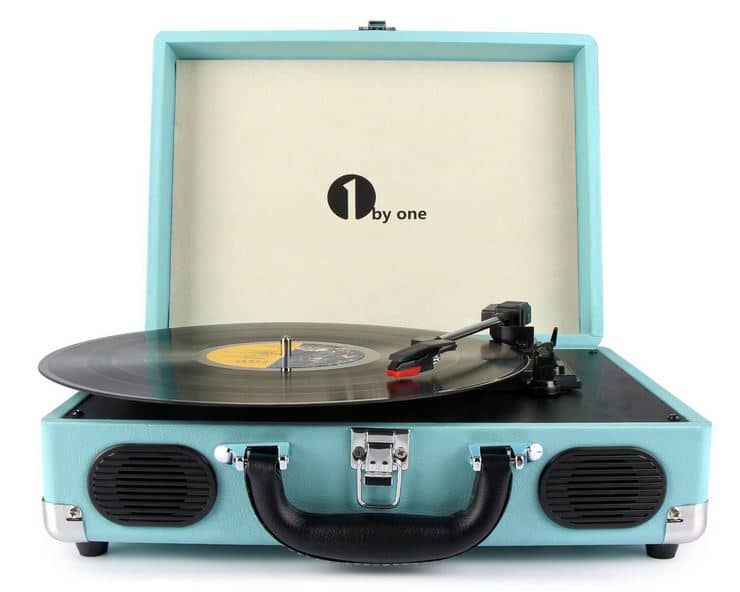
Many beginners are drawn to record players with built-in speakers because they look like a complete solution. Some also include Bluetooth input, so they can act as a speaker for your phone.
Built-in speakers are convenient, but they are often limited by size and placement. A speaker built into the same cabinet as the turntable can also be close to the stylus and tonearm, which is not ideal for vibration control.
Wireless Bluetooth speakers can give more freedom. You can place the speaker away from the turntable, which may help reduce vibration and improve stereo spread if you use a pair of speakers.
Powered Bluetooth bookshelf speakers are often a strong beginner route. They keep the system simple, but they usually sound more substantial than tiny built-in speakers. Some powered speakers also offer wired inputs, which gives you another path if you later decide to stop using Bluetooth.
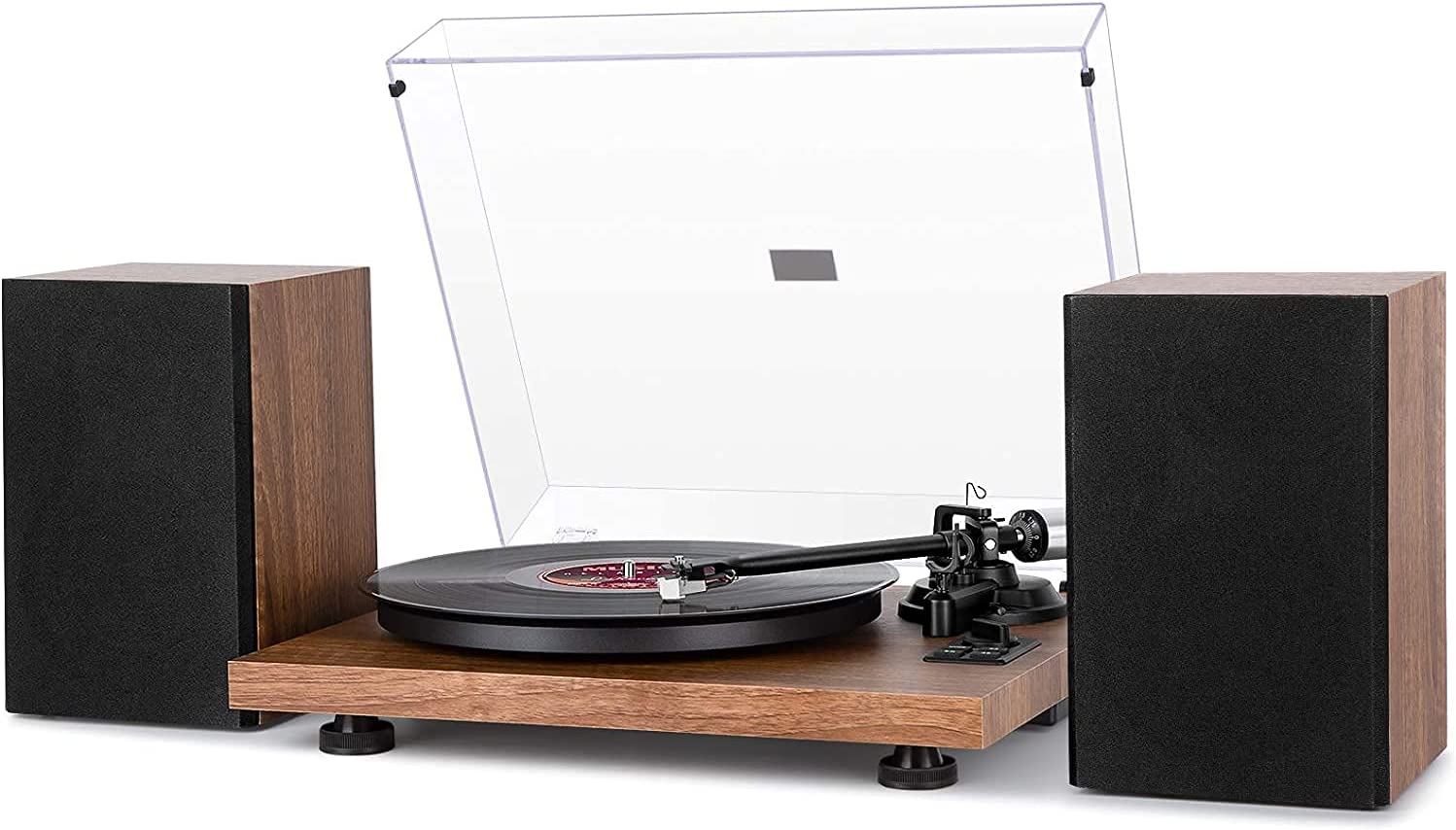
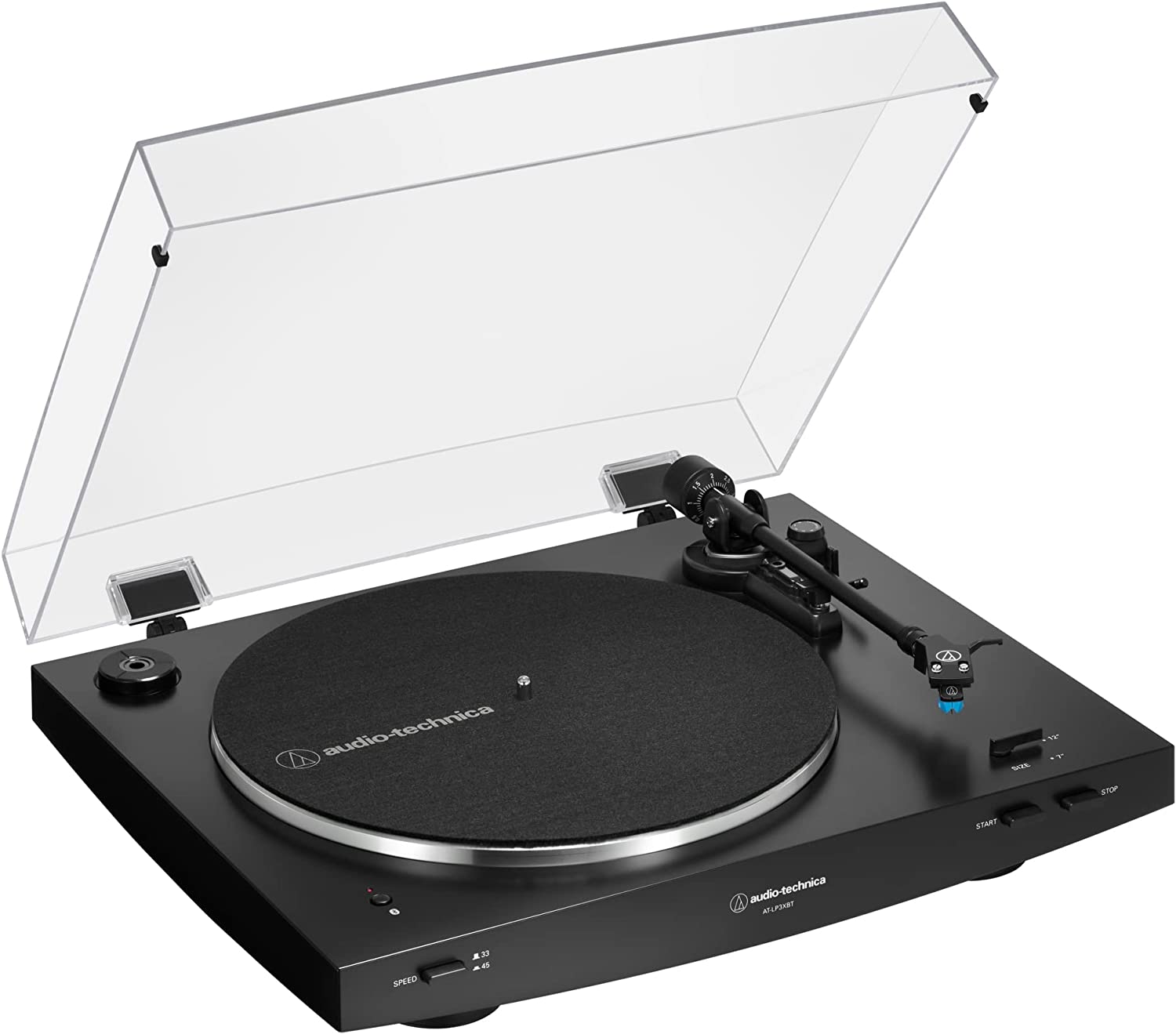
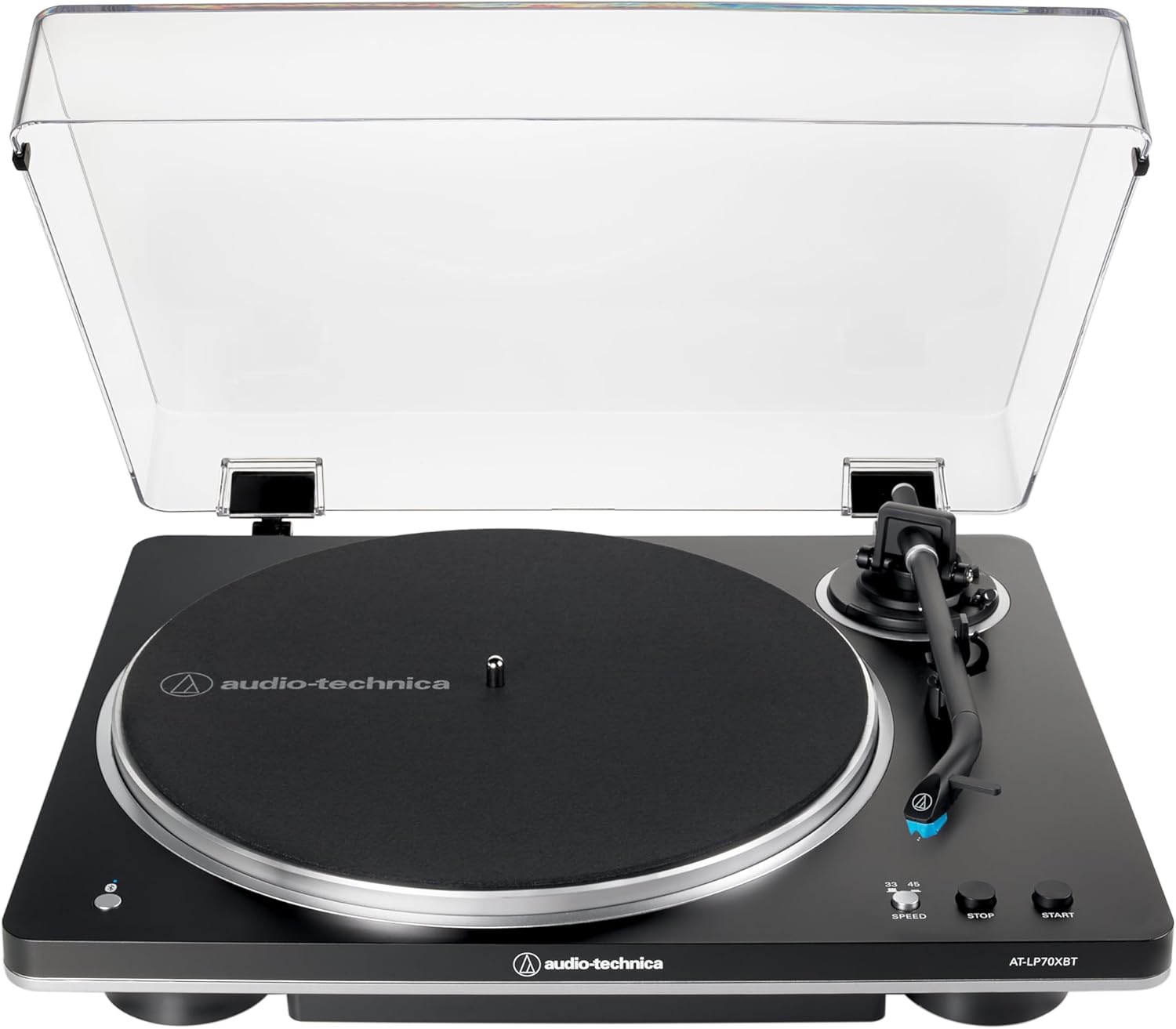
For example, the local catalogue includes Bluetooth turntables such as the Audio-Technica AT-LP60XBT Turntable, Audio-Technica AT-LP3XBT Automatic Wireless Turntable, Audio-Technica AT-LP70XBT Record Player, House of Marley Revolution Wireless Turntable and Lenco LS-300 Bluetooth Record Player. It also includes powered Bluetooth speaker options such as the Edifier R1280DB Powered Bluetooth Bookshelf Speakers. These are examples of the types of products you may see when comparing setups, not automatic recommendations.
When comparing options, think in systems rather than single products. A better turntable connected to weak speakers will still sound limited, while good speakers can make a modest turntable more enjoyable.
7. Wired outputs still matter
Even if you want Bluetooth today, wired outputs are worth having. They make the turntable more flexible and can extend its useful life.
A turntable with RCA outputs can connect to powered speakers, an amplifier, a hi-fi receiver or an external phono preamp. RCA plugs are the common red and white audio connectors used for left and right channels.
Some turntables have a switch labelled “phono/line”. In “phono” mode, the signal needs a phono preamp elsewhere in the system. In “line” mode, the built-in preamp is active and the turntable can connect to many powered speakers or line inputs.
This switch is useful because it lets your system grow. You might start with Bluetooth, then later connect by cable to better speakers or an amplifier without replacing the turntable.
A wired connection also avoids Bluetooth pairing issues, wireless dropouts and audio compression. If two models seem similar, the one with clearer wired connection options is usually the safer long-term buy.
Before buying, check whether the turntable has:
- Bluetooth output if you want wireless vinyl playback
- RCA output for future wired use
- A built-in phono preamp or a clear phono/line switch
- A replaceable stylus
- A tonearm with suitable tracking force control, where available
These features matter more than styling alone. A turntable is a mechanical playback device, so basic record care and stable operation should come before decorative extras.
8. How to choose a Bluetooth turntable as a beginner
Start with your listening goal. A buyer who wants casual wireless listening in a small flat has different needs from someone planning to build a hi-fi system over several years.
Use these decision points:
- Choose Bluetooth output if you want to hear records through wireless speakers or headphones.
- Choose Bluetooth input only if you mainly want the unit to act as a speaker for your phone.
- Choose built-in speakers only if convenience and space matter more than sound quality.
- Choose powered Bluetooth speakers if you want simple setup with better speaker placement.
- Choose wired outputs if you want an upgrade path.
- Choose automatic operation if you are nervous about cueing the tonearm manually.
Automatic turntables can start and return the tonearm at the press of a button. Manual turntables require you to place and lift the tonearm yourself. Neither is automatically better; it depends on confidence, budget and how hands-on you want the experience to be.
Check stylus replacement before you buy. A stylus wears with use and should be replaceable without replacing the whole record player. If replacement styli are hard to identify, that is a warning sign.
Also check whether the turntable supports 33⅓ and 45 rpm speeds. Most albums play at 33⅓ rpm, while many singles play at 45 rpm. Some older or specialist records may need 78 rpm, but that is not essential for most beginners.
Finally, avoid choosing by Bluetooth alone. A poorly made turntable does not become a good one because it has wireless features. Look for a sensible balance of cartridge, arm, speed stability, outputs and speaker choice.
9. How to set up Bluetooth playback
Pairing is usually simple, but it can be frustrating if several devices are trying to connect at once. Do the first setup slowly and keep the manual nearby.
A typical process is:
- Place the turntable on a level, stable surface.
- Fit the belt, platter, mat and counterweight if your model requires assembly.
- Remove any stylus guard before playing a record.
- Put your speaker or headphones into Bluetooth pairing mode.
- Put the turntable into Bluetooth pairing mode.
- Wait until the connection light or sound confirms pairing.
- Start the record and raise the volume gradually.
If you hear no sound, check the simple things first. Make sure the receiving speaker is on the correct input, the turntable is not muted, and the stylus is actually touching the record.
If the sound is very quiet through a wired connection, the turntable may be set to phono output when your speaker expects line level. If the sound is distorted, it may be set to line output into an input designed for phono. Matching the output and input type is important.
For Bluetooth headphones, remember that some models auto-connect to your phone as soon as they turn on. Disconnect them from the phone before pairing them with the turntable.
Keep volume modest at first. Records can vary in level, and sudden loud output through headphones is unpleasant.
10. When Bluetooth is the right choice, and when it is not
Bluetooth is the right choice when simplicity is your priority. It is also useful where cables would be awkward, where you want headphone listening, or where you already own good Bluetooth speakers.
It is less ideal if you are buying vinyl mainly for the best possible sound quality. A wired system with properly placed speakers will usually be more reliable and more upgradeable.
Bluetooth is also not a cure for poor record condition. Dust, scratches, worn styli and warped records will still be heard through a wireless speaker. Good cleaning habits and a healthy stylus matter just as much.
A sensible beginner approach is to buy a turntable that can do both. Use Bluetooth when convenience matters, and keep the option of wired listening for later.
That way, your first purchase does not trap you. You can start simply, learn what you enjoy, then decide whether better speakers, a phono stage or a more traditional amplifier setup is worth exploring.
At a glance comparison
| Bluetooth turntable with output | Best for sending vinyl sound to Bluetooth speakers or headphones. Convenient, but audio is converted and may be compressed. |
|---|---|
| Bluetooth record player with input | Best for playing phone or tablet audio through the record player’s speakers. It may not send records wirelessly. |
| All-in-one record player | Simple and compact, often with built-in speakers. Sound and upgrade options are usually more limited. |
| Turntable plus powered Bluetooth speakers | A practical beginner system with better speaker placement. Often allows both Bluetooth and wired connections. |
| Traditional wired turntable system | Usually best for sound quality, reliability and upgrading. Requires more care when matching turntable, phono stage, amplifier and speakers. |
Frequently asked questions
Can I use any Bluetooth speaker with a Bluetooth turntable?
Usually, yes, if the turntable has Bluetooth output and the speaker has Bluetooth input. However, pairing behaviour varies, and some speakers prefer to reconnect to a phone they already know.
For best results, pair the speaker close to the turntable first. If it fails, disconnect or forget the speaker from other devices temporarily.
Can I connect Bluetooth headphones to a turntable?
Yes, if the turntable can transmit Bluetooth audio. Put the headphones into pairing mode and then start pairing from the turntable.
Be aware that some headphones may introduce a small delay. This is usually fine for music listening, but you may notice it if you can also hear the stylus quietly playing the record nearby.
Does Bluetooth ruin the point of vinyl?
Not necessarily. Vinyl is also about record collecting, artwork, the physical routine and enjoying albums intentionally.
From a sound quality point of view, Bluetooth is not the purest route because the signal is converted for wireless transmission. If the listening experience matters more than technical purity, it can still be a very enjoyable way to start.
Do I still need an amplifier with a Bluetooth turntable?
Not if you are sending the sound to Bluetooth speakers or Bluetooth headphones. Those devices contain their own amplification.
You may need an amplifier if you want to use passive speakers. Passive speakers do not power themselves, so they need an amplifier between the turntable and speakers.
Why is my Bluetooth turntable quiet when connected by cable?
The most common cause is a phono and line level mismatch. If your turntable is set to phono, the signal is very low and needs a phono preamp.
If your speaker or amplifier expects a normal line signal, set the turntable to line if it has that option. If it has no built-in preamp, you will need an external phono preamp.
Can a Bluetooth turntable connect to a soundbar?
It can if the turntable has Bluetooth output and the soundbar can receive standard Bluetooth audio. This can be a tidy solution for casual listening.
Soundbars are designed mainly for television sound, so stereo music quality varies. If music is your priority, powered bookshelf speakers may be a better long-term choice.
Is a USB turntable the same as a Bluetooth turntable?
No. USB is mainly for connecting the turntable to a computer, often to record or digitise vinyl. Bluetooth is for wireless playback to speakers or headphones.
Some products include both features, but one does not automatically mean the other. Check the connection list carefully before buying.
Will Bluetooth speakers vibrate the record player less than built-in speakers?
They can, because you can place them away from the turntable. This reduces the chance of speaker vibration reaching the stylus and tonearm.
Keep any speaker, wired or wireless, on a separate surface if possible. A stable turntable position helps prevent skipping, feedback and muddy bass.
Final thoughts
A Bluetooth turntable is a practical way to begin with vinyl if you want fewer cables and an easier first setup. The key is to understand what kind of Bluetooth you are buying: output for wireless vinyl playback, input for streaming from a phone, or both.
For most beginners considering wireless playback, the safest choice is a turntable with Bluetooth output, a replaceable stylus, RCA wired outputs and a built-in phono preamp or phono/line switch. Pair it with decent powered Bluetooth speakers or headphones, and keep the wired option available for the future.
If you are still unsure, your next step should be to learn the basics of phono preamps and powered speakers. Those two topics will make turntable listings much easier to understand and help you choose a system that can grow with you.