Introduction
The Sony PS-HX500 USB Vinyl Turntable is a manual belt-drive record player built for people who want analogue playback and serious vinyl archiving in one unit. Its defining appeal is USB recording to a computer, including high-resolution DSD and PCM file capture through Sony’s Hi-Res Audio Recorder software.
Watch the product video
This is not an all-in-one player with speakers, Bluetooth or automatic operation. It is better understood as a hi-fi-style turntable with a built-in phono stage and a strong emphasis on preserving records digitally.
The PS-HX500, also seen in the UK as PSHX500.CEK, will make most sense for owners of rare, out-of-print or 12-inch records who want to make careful transfers. If you only want simple record playback, some of its cost and complexity may be going towards features you will not use.
Design and build
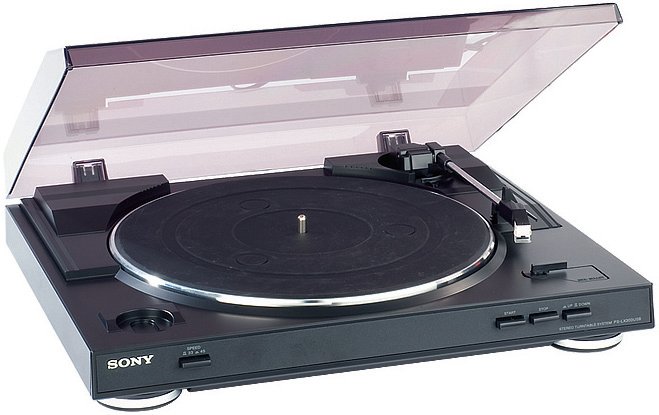
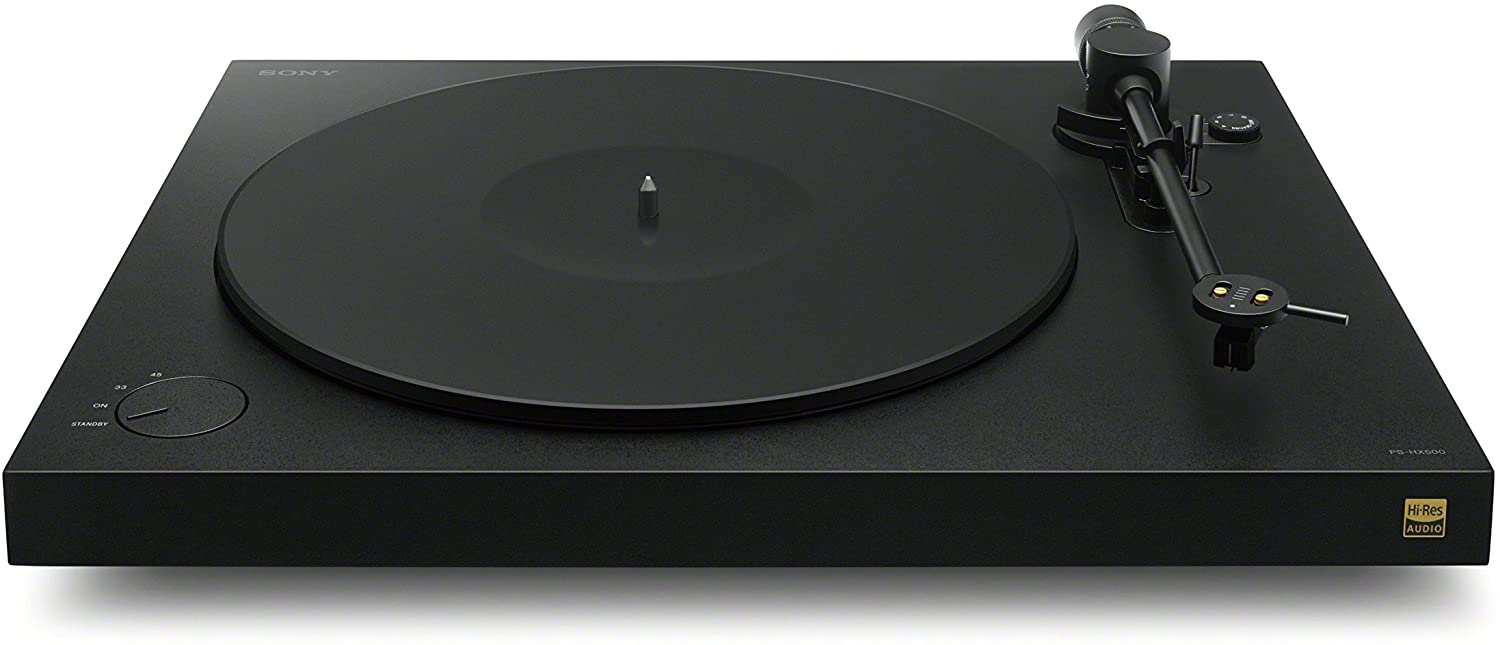
Sony gives the PS-HX500 a discreet, all-black full-plinth design that looks more functional than decorative. The low-profile shape should suit a modern hi-fi rack without drawing much attention to itself.
The construction is based around an MDF plinth, aluminium die-cast platter and 5 mm rubber mat. It uses a belt-drive system with a DC motor, which is a conventional layout for a domestic hi-fi turntable rather than a DJ deck.
At the rear are the practical connections: RCA audio output, grounding terminal, PHONO/LINE switch, USB Type-B port and DC power input. The PHONO/LINE switch is important because it lets the deck feed either a phono input or a normal line-level input.
The straight tonearm has an integrated headshell, counterweight and anti-skating adjustment. A moving-magnet cartridge is supplied and pre-fitted, but Sony does not publicly brand it in the verified manual, so cartridge upgrade choices should be made with care.
Features
The headline feature is high-resolution USB recording. Connected to a computer, the PS-HX500 works with Sony’s Hi-Res Audio Recorder software to capture vinyl as DSD or high-resolution PCM files, with support stated up to DSD 5.6 MHz and PCM/WAV up to 24-bit/192 kHz.
That makes it more specialised than a basic USB turntable. The recording software can handle recording, gain adjustment, marker editing and exporting, although track splitting and metadata still require user involvement.
For normal playback, the built-in phono EQ adds useful flexibility. Set the rear switch to LINE and it can connect to an amplifier or powered speakers with a suitable line input; set it to PHONO if using an amplifier’s phono input or a separate phono stage.
The PS-HX500 also supports user setup through its adjustable counterweight and anti-skating. This gives more control than a sealed plug-and-play beginner deck, but it also means the owner must be comfortable balancing the tonearm and setting tracking force correctly.
Setup
Initial setup is more involved than with a fully automatic starter turntable. The platter and belt need fitting, the rubber mat and dust cover must be installed, then the tonearm has to be balanced before setting the 3 g tracking force and matching anti-skating.
For analogue playback, the main decision is whether to use PHONO or LINE. LINE uses the internal phono EQ for a standard line input, while PHONO is intended for an amplifier’s phono input or an external phono stage, with grounding available to help reduce hum.
Recording adds a computer step. The supplied USB connection is used with Sony’s Hi-Res Audio Recorder, and users should check current operating-system compatibility before relying on the PS-HX500 as an archiving tool.
Performance
In daily use, this is a fully manual turntable. The user selects 33 1/3 or 45 rpm, cues the arm, lowers it onto the record, lifts it at the end and returns it to the arm rest by hand.
Official specifications list belt drive, a DC motor, two-speed operation and wow and flutter of 0.1% WRMS. The PS-HX500 does not support 78 rpm records, and Sony’s own guidance makes clear that it is not intended for DJ use, hand-stopping or reversing records.
Connectivity is practical but specific. The analogue outputs are for playback through a hi-fi system or powered speakers with suitable inputs, while the USB port is for recording to a computer rather than direct playback into USB speakers or a DAC.
The archiving workflow is necessarily real time. Users should expect to record each side as it plays, manage side changes, set levels, add markers and export files, so the feature rewards patience rather than offering automatic ripping convenience.
Sound quality
Based on the supplied moving-magnet cartridge, switchable phono EQ and consistent published assessment, the PS-HX500 is best characterised as a clean, quiet and capable performer for a feature-rich USB deck. Its sound has often been described in broadly smooth or warm terms, while some reports note a lighter and crisper balance depending on system and record condition.
The built-in phono stage is a useful part of the package, especially for amplifiers without a phono input. It should be viewed as a convenient integrated solution rather than a guaranteed replacement for a high-quality external phono stage in a more ambitious analogue system.
For archiving, the quality of the record, stylus condition, setup accuracy and recording levels will matter as much as the file format. High-resolution capture can preserve more information, but it will also preserve surface noise, worn grooves and setup mistakes.
Cartridge upgrades are possible because the arm uses standard half-inch mounting, but the integrated headshell makes changes less convenient than on decks with detachable headshells. The USB recording path is also designed around the supplied cartridge output, so upgrades should be chosen and aligned thoughtfully.
Pros
- High-resolution USB recording with DSD and PCM support Built-in phono EQ with PHONO/LINE switching for flexible system matching Proper manual hi-fi layout with adjustable counterweight and anti-skating Clean, understated design with MDF plinth and aluminium die-cast platter Dedicated Sony recording software for capture, markers, gain adjustment and export Replaceable stylus and possible cartridge upgrade path
Cons
- Fully manual operation with no auto-return or auto-stop No
- Bluetooth, built-in speakers or headphone output USB is for computer recording only, not direct digital playback Archiving takes place in real time and requires manual track and metadata work
- No 78 rpm playback Cartridge changes are less convenient than on turntables with removable headshells
Verdict
The Sony PS-HX500 is a well-targeted turntable for buyers who genuinely want to archive vinyl in high-resolution formats. Its combination of manual belt-drive playback, built-in phono EQ, USB output and dedicated Sony software gives it a clear purpose.
Its limitations are equally clear. It is not automatic, not wireless, not a 78 rpm deck and not a shortcut to effortless digital library building, because recording still takes time and attention.
For the right buyer, those trade-offs are reasonable. If high-resolution vinyl transfer is only a passing curiosity, however, a simpler turntable focused on analogue playback may be the better-value choice.