Introduction
The Denon DP-29F is a fully automatic belt-drive record player designed for simple vinyl playback rather than hands-on hi-fi tweaking. It suits beginners, casual listeners and gift buyers who want a recognised hi-fi brand with one-button operation.
Watch the product video
In UK retail listings, the DP29FE2 or DP29FE2GB naming appears to refer to the silver UK variant of the DP-29F rather than a materially different model. That distinction matters because it should not be confused with Denon’s more adjustable DP-300F or its higher-end turntables.
This is not an all-in-one player with speakers, Bluetooth or USB recording. It is best viewed as a compact starter deck for use with an amplifier and speakers, or with powered speakers that have a suitable line input.
Design and build
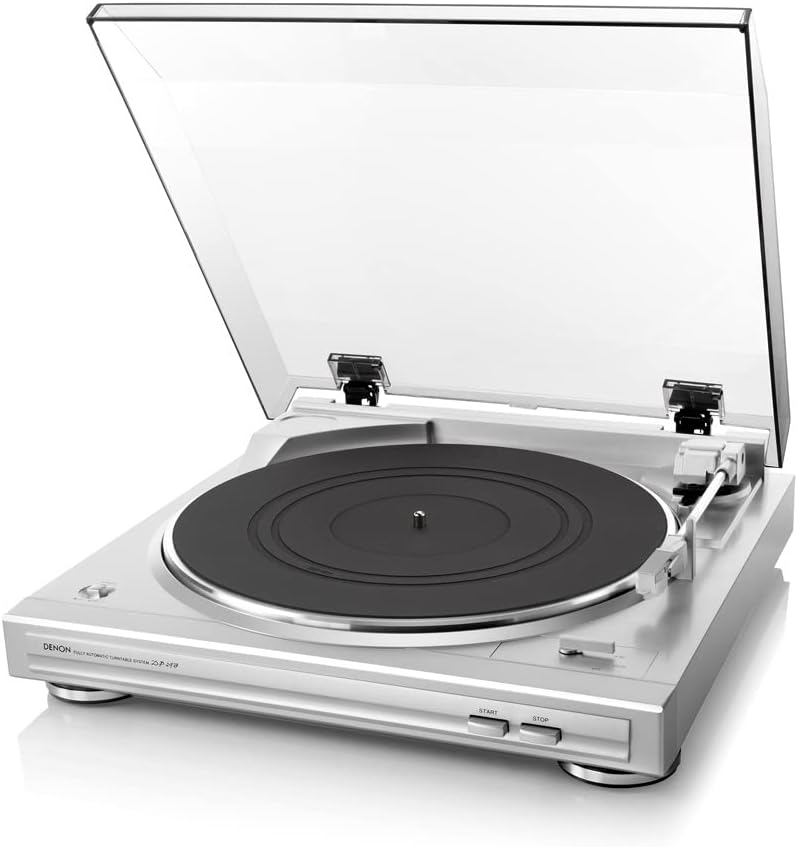
The DP-29F has a compact, low-profile form that should fit easily into small hi-fi systems or desktop-style listening spaces. Its silver finish and simple control layout give it a clean, functional appearance rather than a statement hi-fi look.
Denon describes the platter construction as rigid die-cast aluminium with uniform inertial mass, and the deck uses a rubber mat on top. At 2.8 kg, however, it is a lightweight design, so it needs a firm, level support and sensible distance from loudspeakers to reduce vibration and feedback issues.
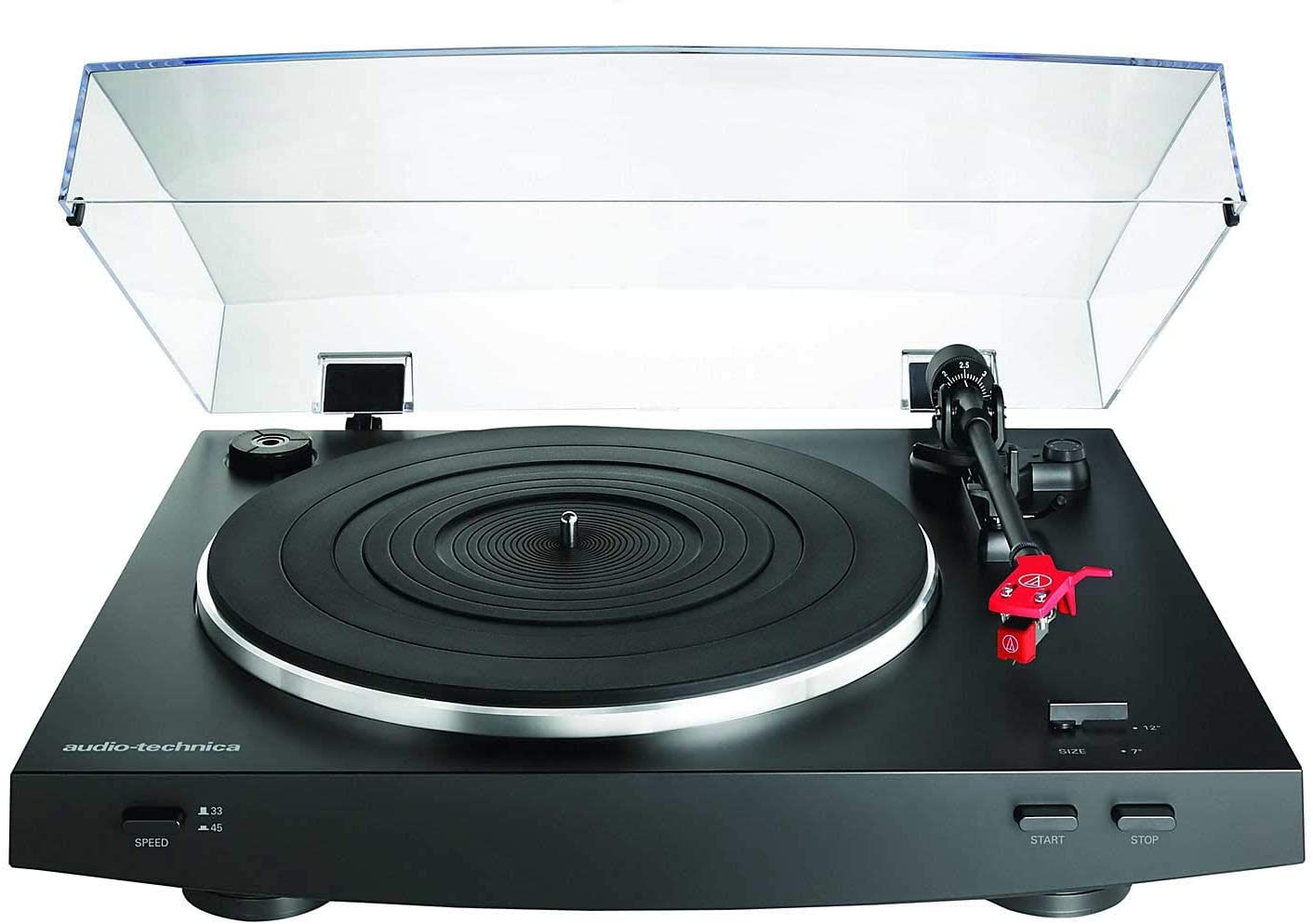
The controls are deliberately straightforward, with start and stop buttons, speed selection and a size selector for the automatic system. The supplied dust cover adds everyday practicality, while the built-in equaliser switch is placed to support either line-level or phono-stage connection.
Features
The main attraction is fully automatic operation. Pressing start begins playback, and at the end of a normal record side the arm returns to its rest and the platter stops, reducing the amount of manual cueing required.
A switchable built-in phono equaliser makes system matching easier. With the equaliser on, the turntable can feed an AUX, line or powered-speaker input; with it off, it can be connected to a proper PHONO MM input on an amplifier.
Denon supplies the DP-29F with a moving-magnet cartridge and specifies the DSN-82 stylus as the replacement part. The deck plays 33⅓ and 45 rpm records, and a 45 rpm adaptor is included for large-centre 7-inch singles.
The convenience comes with limits. There is no official support for Bluetooth, USB output, built-in speakers or headphone listening, and the tonearm does not offer the adjustable counterweight and anti-skate controls that enthusiasts often want.
Setup
Setup is simple by hi-fi turntable standards, although it is not quite as immediate as a one-piece portable player. The platter is fitted to the spindle, the belt is positioned around the driving roller, the mat is placed on top and the deck is connected to the chosen input.
The most important step is setting the equaliser switch correctly. Use the line/AUX setting for powered speakers or standard line inputs, and switch the equaliser off when connecting to a proper PHONO MM input.
Daily use is deliberately undemanding. Remove the stylus cover, choose the speed and record size, press start for automatic playback, or move the arm manually with the finger lever when a non-standard start point is needed.
Performance
Day to day, the DP-29F is built around ease rather than customisation. The automatic start and return system is the feature that makes it stand out for nervous first-time users or anyone who dislikes lowering the stylus by hand.
The belt-drive system uses a DC servo motor, and Denon specifies wow and flutter at around 0.15% WRMS. That is consistent with an entry-level automatic turntable intended for normal domestic listening rather than a deck aimed at close adjustment or specialist speed tuning.
Connectivity is practical as long as expectations are clear. The RCA output and switchable equaliser allow use with many amplifiers and powered speakers, but the DP-29F still needs an external amplification and speaker system.
The automatic mechanism has some format limitations. The manual states that 25 cm records should not be used with automatic playback, and some records with grooves extending beyond the usual return point may not suit the auto-return behaviour.
Sound quality
The DP-29F should be judged as a convenience-led starter turntable, not as a platform for extracting the last detail from a record collection. Its supplied MM cartridge, fixed 3.5 g tracking force and built-in phono equaliser point towards straightforward, accessible playback.
Denon lists a 20 Hz to 20 kHz frequency range, but that figure does not by itself guarantee refined performance in every system. The final result will depend heavily on the amplifier, speakers, placement and the condition of the records and stylus.
Owner comments commonly describe the sound as acceptable or enjoyable for casual listening, especially in starter systems. More demanding listeners are likely to find the limited cartridge choice, fixed setup and lightweight construction restrictive over time.
Pros
- Fully automatic start and return is beginner-friendly Built-in switchable phono equaliser simplifies connection options Supplied MM cartridge means no cartridge choice is needed at setup Supports 33⅓ and 45 rpm playback, including 7-inch singles with adaptor
- Compact, lightweight design suits small systems Replaceable DSN-82 stylus provides a clear maintenance route
Cons
- Fixed 3.5 g tracking force with no standard user adjustment
- No user-adjustable anti-skate specified Limited cartridge-upgrade path compared with more flexible starter decks No
- Bluetooth, USB output, built-in speakers or headphone socket Lightweight 2.8 kg construction needs careful placement Automatic playback is not suitable for 25 cm records
Verdict
The Denon DP-29F is a sensible entry-level automatic turntable for listeners who value simplicity above adjustment. Its automatic operation, built-in phono equaliser and supplied MM cartridge make it approachable for a first vinyl setup.
Its weaknesses are equally clear. The lightweight build, fixed tracking force, lack of anti-skate adjustment and limited cartridge path mean it is not a long-term enthusiast platform.
It is most persuasive when bought as a straightforward starter deck for an existing amplifier or powered-speaker system. If Bluetooth, USB or upgrade flexibility are priorities, spending more on a better-equipped alternative will be the wiser route.