Introduction
Wharfedale Diamond 9.1 Speakers are passive bookshelf loudspeakers for a traditional hi-fi system, not a record player and not an all-in-one powered speaker set. They suit vinyl buyers who already own, or plan to buy, a separate amplifier and phono stage.
Watch the product video
The Diamond 9.1 sits in the budget hi-fi space and has a long-standing reputation as a compact, smooth-sounding speaker for small and medium rooms. Its appeal is strongest for first passive systems, bedroom setups, offices and near-field listening rather than large-room party use.
For turntable owners, the key point is system matching. These speakers can be a sensible vinyl partner, but only when the turntable signal is amplified correctly and the speakers are placed with some care.
Design and build
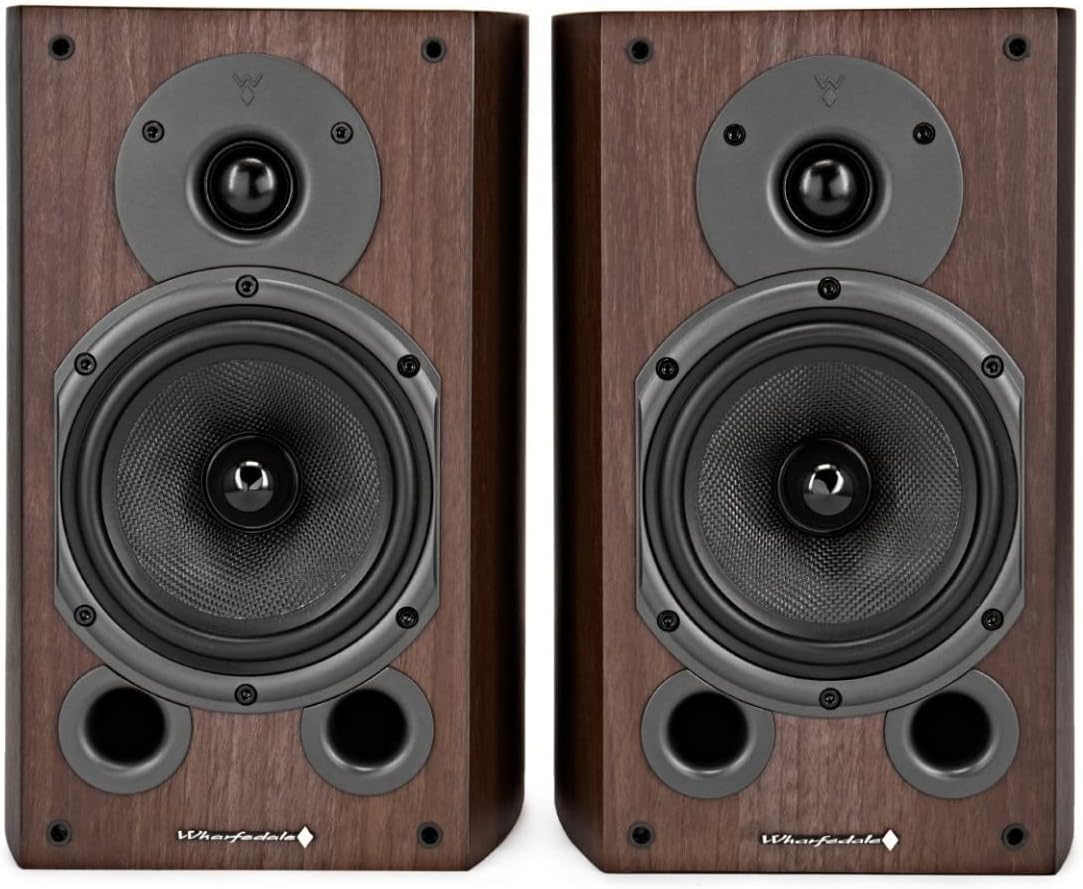
The Diamond 9.1 is a compact two-way standmount speaker with a soft textile dome tweeter and a Kevlar mid/bass driver. The cabinet is curved and internally braced, which is a more considered construction than a plain square budget box.
Its reflex-loaded cabinet is designed to help a small enclosure produce fuller bass. Current retail information describes twin front reflex ports, although the older specification is more general about reflex loading, so placement should still be treated as important rather than foolproof.
There are no onboard controls, screens or input selectors because this is a conventional passive speaker. Connections are made through bi-wireable binding posts, with standard single wiring the simplest starting point when the terminal links are in place.
The proportions are compact enough for stands, shelves or furniture, but these speakers are not a premium furniture-style design. The finish and vinyl wrap are practical for the price category, though buyers expecting real wood veneer or a luxury cabinet may want to look higher up the range.
Features
The most important feature is the passive hi-fi design. You need a stereo amplifier, AV receiver or compact hi-fi receiver, and a turntable also needs a phono preamp unless that is already built into the turntable or amplifier.
The two-way driver layout uses a dedicated tweeter for treble and a Kevlar mid/bass driver for the rest of the range. This is the normal architecture for compact hi-fi speakers and gives the Diamond 9.1 a more serious system role than basic turntable accessory speakers.
Its 6-ohm nominal impedance, 86 dB sensitivity and commonly stated 20–100 W amplifier guidance mean amplifier choice matters. It does not need exotic equipment, but it is not the best match for very low-powered amplification in larger rooms.
Bi-wireable terminals add flexibility, although most buyers should begin with ordinary single-wire connection. Removable grilles are useful for protecting the drivers, especially in shared rooms or homes with children or pets.
Setup
Setup is straightforward but not one-cable simple. Connect speaker cable from the amplifier to each speaker, keep red-to-red and black-to-black polarity consistent, and leave the metal terminal links in place if using standard single wiring.
For vinyl, make sure the turntable is routed through a phono stage before the amplifier sends signal to the speakers. If the sound is vague, thin or poorly centred, checking speaker polarity is one of the first practical troubleshooting steps.
Stands are strongly recommended where possible, with tweeters around seated ear height and a slight toe-in towards the listener. A rigid shelf can work, but avoid burying the speakers deep in a bookcase and experiment with wall distance to prevent boomy or indistinct bass.
Performance
Day-to-day operation is simple once the system is assembled: the speakers take a signal from an amplifier and have no power switch, volume knob or input mode of their own. Volume, source selection and tone control, if available, all happen upstream.
Turntable-specific issues such as speed stability, automation and cartridge alignment do not apply to the Diamond 9.1 itself. Those factors belong to the record player, while the speakers’ role is to reproduce the amplified signal they are given.
Connectivity is deliberately traditional. There is no Bluetooth, USB, HDMI, optical input, DAC, phono stage or built-in amplifier, so anyone wanting plug-and-play playback from a turntable should consider active speakers instead.
Within its intended role, the Diamond 9.1 is best viewed as a compact small-room speaker. It can also be used in home cinema as front or surround speakers, but for cinema impact or heavier bass it makes sense to partner it with a subwoofer and set it appropriately through an AV receiver.
Sound quality
Available evidence points to a smooth, balanced and slightly warm-to-neutral presentation rather than a bright or aggressive sound. Published commentary has repeatedly highlighted midrange clarity, treble refinement and good value, which are useful traits for vinyl systems.
The compact cabinet and 50 Hz–24 kHz stated frequency response indicate sensible bandwidth for the size, but not deep sub-bass. Some reports also note extra upper-bass weight, so rear-wall distance and shelf placement can affect whether the balance sounds full or a little thick.
For records, this character should suit listeners who want voices, guitars and everyday albums to sound easy-going rather than etched. It is less suitable for buyers expecting large-scale dynamics, club-level bass or room-filling output from a small pair of speakers alone.
A suitable amplifier and phono stage will strongly influence the final result. The Diamond 9.1 is a value-focused speaker, so improving placement and system matching is likely to matter more than chasing optional tweaks such as bi-wiring at the outset.
Pros
- Smooth, non-aggressive balance suits long vinyl listening sessions
- Compact size works well in bedrooms, offices and small rooms Proper passive hi-fi design with two-way drivers and bi-wireable terminals Curved, braced cabinet is a notable construction feature at the budget level
- Good reputation for value among budget hi-fi and vinyl system owners
- Can be used in stereo or home cinema systems with suitable amplification
Cons
- Requires a separate amplifier and, for many turntables, a phono stage No
- Bluetooth, DAC, optical input, USB, HDMI or volume control Limited deep bass and large-room scale compared with bigger speakers Modest 86 dB sensitivity means amplifier headroom matters Placement on shelves or near walls can make bass less controlled
- Some ambiguity exists around versions and current-stock differences
Verdict
The Wharfedale Diamond 9.1 remains a sensible budget passive speaker for vinyl systems where compact size, smooth balance and value are the priorities. It is not a modern powered convenience product, but as part of a properly amplified hi-fi setup it has clear appeal.
Its main limitations are exactly what buyers should expect from a small passive bookshelf speaker: no built-in electronics, limited deep bass and a need for careful placement. Those trade-offs are manageable in small and medium rooms but become more obvious with loud playback or bass-heavy material.
If you already have a suitable amplifier, or are building a first separates system around a turntable, the Diamond 9.1 is worth considering. If you want immediate plug-and-play simplicity, active speakers will be a better fit.