Introduction
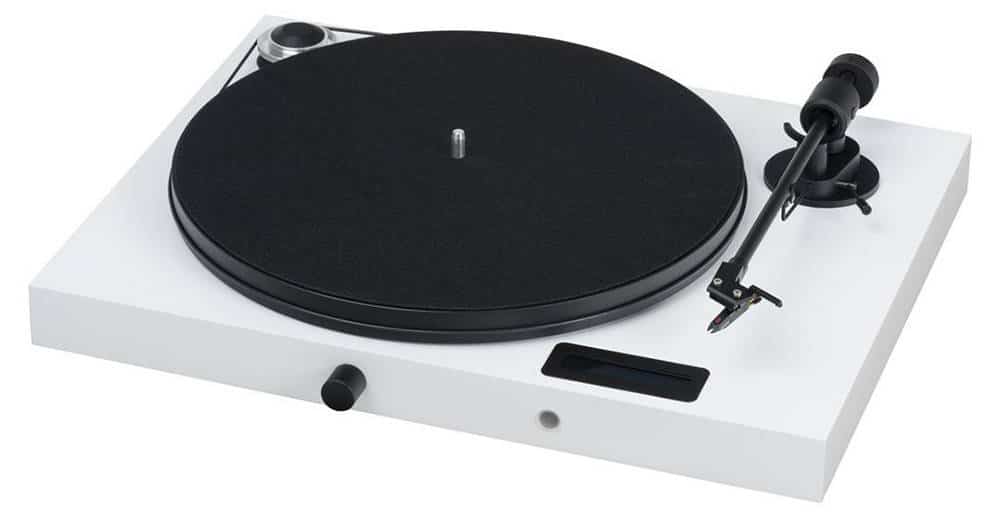
Pro-Ject Juke Box E is an all-in-one belt-drive turntable system for buyers who want a credible vinyl setup without building a full separates system from scratch. It combines a record player, moving-magnet phono stage, Bluetooth receiver, line pre-amplifier and power amplifier in one plinth, so the intended setup only needs a pair of passive speakers.
Watch the product video
Its appeal is strongest for beginners, small-room listeners and anyone who wants fewer boxes and cables. The exact model here is the original Juke Box E, not the later Juke Box E1, which has revised specifications and should be considered separately.
As the original Juke Box E appears to be no longer available through the UK distributor, it is best viewed as a used, clearance or old-stock option. Condition, completeness and sensible pricing matter more than they would with a current model.
Design and build
The Juke Box E uses a high-gloss plinth that houses both the turntable and the amplifier electronics. Supported specification information lists an MDF plinth, particle-board platter, stainless-steel bearing and a pre-set 8.6-inch aluminium tonearm.
It is more substantial in concept than a suitcase-style record player because the speakers are separate rather than built into the same cabinet. That matters for stereo separation and helps avoid the most basic vibration problems associated with record players that include speakers in the lid or chassis.
The layout is busy but practical. There is a top display, a front rotary/push control, underside rocker switches for the turntable and amplifier sections, plus rear connections for passive speakers, line input, line/phono outputs and the Bluetooth antenna.
This integration is also the main compromise. A separate turntable, phono stage and amplifier can be upgraded or replaced independently, whereas the Juke Box E ties several key parts of the system into one unit.
Features
The headline feature is the built-in power amplifier, rated at 2 x 50 W into 4 ohms, with review and retailer sources also describing 25 W per channel into 8 ohms. This allows passive speakers to be connected directly, which is unusual for a turntable and makes the Juke Box E a compact stereo hub rather than just a record deck.
A built-in MM phono stage works with the supplied Ortofon OM 5E moving-magnet cartridge. The cartridge is pre-mounted and uses a replaceable stylus, with the Ortofon Stylus 5E as the direct replacement and other OM-family styli offering possible upgrade routes if set up correctly.
Bluetooth 2.1 + EDR is included as a receiver input, so a phone, tablet or computer can stream into the system. It should not be mistaken for Bluetooth output: there is no supported evidence that it transmits to wireless headphones or Bluetooth speakers.
The line-level RCA input adds useful flexibility for a CD player, streamer, TV audio output or another suitable source. Line and phono outputs also provide some system flexibility, including the option to feed external amplification if the internal amplifier becomes the limiting factor.
Setup
Setup is designed to be approachable for a first system. The cartridge, tracking force and anti-skating are pre-set from the factory, so the main tasks are positioning the deck on a stable surface, fitting the belt, connecting the external 24 V power supply and wiring passive speakers to the speaker outputs.
Daily use still requires some turntable knowledge. Speed changes are manual, records need to be cued by hand, and the underside power switches and remote-control logic may take a little familiarisation.
If buying used, check that essential parts are present, including the power supply, dust cover, remote, counterweight, belt and a healthy OM 5E stylus. It is also sensible to check both amplifier channels, Bluetooth pairing, line input operation, cueing action, motor noise and speed stability before committing.
Performance
In everyday use, the Juke Box E is a manual belt-drive turntable. The user cues the arm, starts and stops playback manually, and changes between 33 and 45 RPM by moving the belt on the stepped pulley.
Official figures list speed variance of 0.8% at 33 RPM and 0.7% at 45 RPM, with wow and flutter stated at 0.29% and 0.27% respectively. Those figures place it in practical entry-level hi-fi territory rather than the realm of higher-end speed-control systems.
The integrated amplifier is convenient, but speaker choice is important. Professional feedback consistently points towards reasonably sensitive passive speakers, particularly if the system will be used in a larger room or at higher volumes.
Connectivity is broad for such a compact product, but not modern in every respect. Bluetooth is useful for casual streaming, while the wired line input is likely to be the more dependable route for non-vinyl sources where sound quality and stability matter.
Sound quality
The Juke Box E is best understood as a compact, easy-going hi-fi system rather than a high-powered audiophile separates package. Its use of an Ortofon OM 5E cartridge, separate speakers and an integrated MM phono stage gives it stronger fundamentals than basic all-in-one players with built-in speakers.
Professional review evidence describes the vinyl presentation as broadly balanced and listenable, with a slightly warm character and decent rhythmic ability. Bass authority and ultimate punch are more dependent on speaker matching and room size than with a more powerful separate amplifier.
The internal amplifier is the likely bottleneck when paired with insensitive speakers or pushed to high levels. Imaging, sparkle and dynamic grip have also been described more cautiously by some reviewers than by others, so expectations should remain realistic.
Bluetooth should be treated as a convenience feature, not the best-quality source. For serious listening, vinyl playback or a good wired source through the line input is the more convincing reason to consider this product.
Pros
- Combines turntable, MM phono stage
- Bluetooth receiver, pre-amplifier and power amplifier in one unit Drives passive speakers directly, reducing box count and cable clutter Supplied with a pre-mounted Ortofon OM 5E cartridge with replaceable stylus Line input makes it useful with a CD player, streamer or other line-level source Separate speakers avoid the main drawbacks of record players with built-in speakers Line and phono outputs give some flexibility for external system use
- Good fit for small rooms and beginner vinyl systems
Cons
- Original Juke Box E appears discontinued, so availability is likely to be used, clearance or old stock
- Bluetooth is input only and does not transmit to wireless headphones or Bluetooth speakers
- Manual belt speed change is less convenient than electronic speed switching Built-in amplifier can be limiting with insensitive speakers or larger rooms Less upgradeable than separate turntable, phono stage and amplifier components Control layout, remote and underside switches may not feel immediately intuitive
Verdict
The Pro-Ject Juke Box E remains an interesting answer to a common beginner problem: how to build a proper-looking vinyl system without buying and matching several separate components. Add suitable passive speakers and it can serve as a compact hub for records, Bluetooth streaming and one wired line source.
Its strengths are convenience, reduced clutter and better fundamentals than cheap record players with built-in speakers. Its weaknesses are equally clear: limited upgrade flexibility, manual speed changing, dated Bluetooth and an amplifier that needs sympathetic speaker matching.
As a discontinued original model, it makes most sense at the right used or clearance price and only if the all-in-one format is genuinely useful. If the asking price is close to newer alternatives, compare carefully with the Juke Box E1 or a conventional turntable-plus-amplifier system before buying.