Introduction
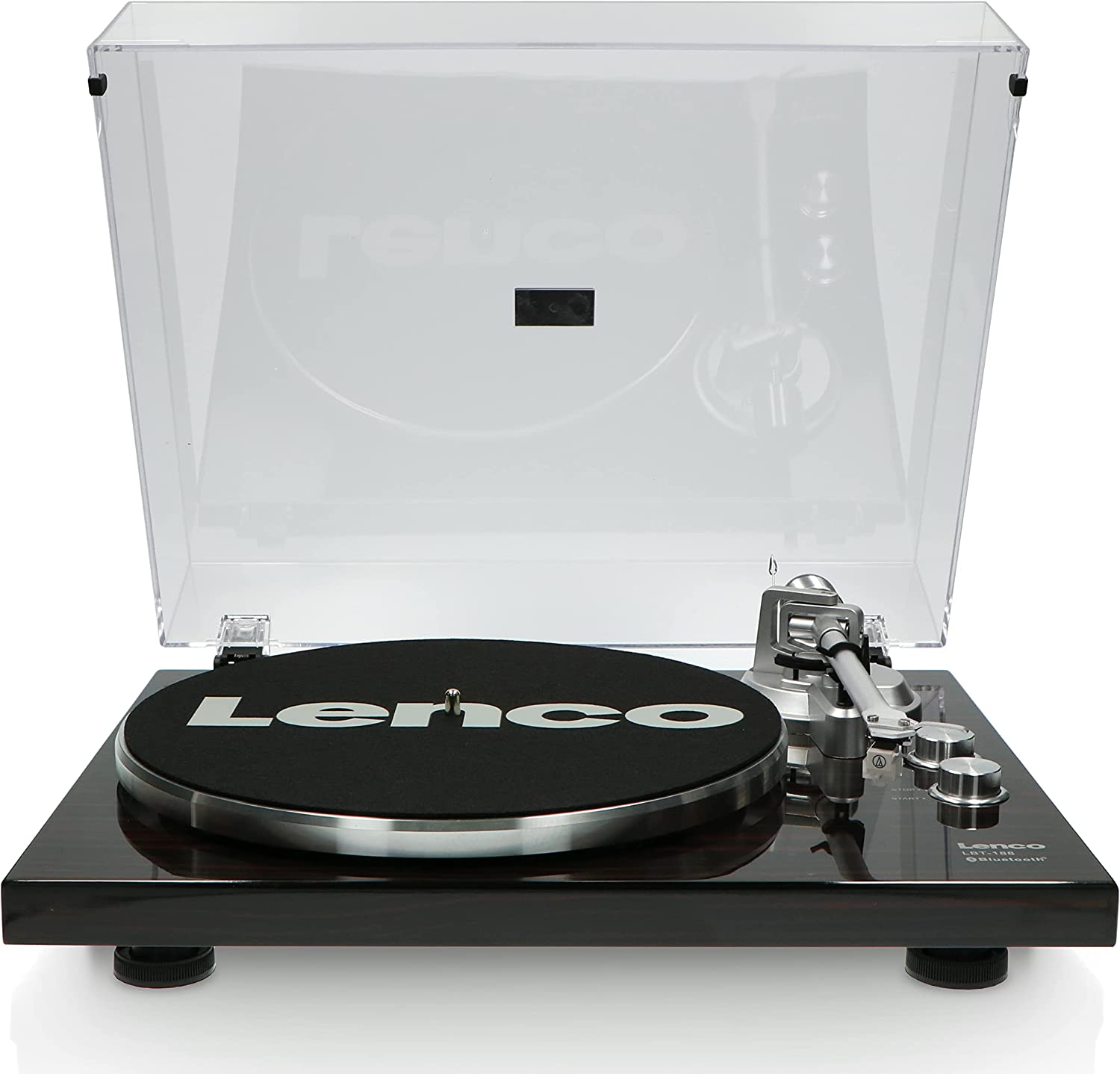
The Lenco LBT-188 Turntable is a manual belt-drive record player with Bluetooth transmission, USB computer recording and a switchable phono stage. It is aimed at buyers who want a proper starter deck with more flexibility than an all-in-one suitcase player.
Watch the product video
This review is focused on the walnut/dark-brown LBT-188WA version, which sits within the wider LBT-188 family. It suits beginners who are willing to learn basic tonearm setup and want to connect by RCA, Bluetooth or USB depending on the system they use.
It is not the simplest possible first turntable, because tracking force and anti-skating need to be set correctly. In return, it offers a more adjustable and serviceable platform than many fixed-force entry-level players.
Design and build
The LBT-188 has a slim, living-room-friendly look, with a walnut-style dark wood finish on the LBT-188WA version. Its low-profile shape and removable dust cover make it feel closer to a conventional hi-fi turntable than a portable record player.
Build elements include an aluminium or metal platter, a metal tonearm, an adjustable counterweight and a replaceable half-inch-mount cartridge. The supplied Audio-Technica AT3600/AT-3600L moving-magnet cartridge is an entry-level but serviceable choice.
Practical construction is budget-conscious rather than luxurious. The hanging anti-skating weight is a functional design, but it can be fiddly for new users and needs care when setting up.
Placement matters with this deck. It should be used on a stable, low-resonance surface and kept away from knocks, speaker vibration and wobbly furniture.
Features
The headline feature set is unusually broad for a starter turntable. The LBT-188 offers stereo RCA output, Bluetooth transmission and USB-B output for recording to a computer.
Its built-in phono pre-amplifier is switchable, so the RCA output can be set to LINE for powered speakers or normal amplifier inputs, or to PHONO for an amplifier with a phono input or an external phono stage. That gives buyers room to start simply and improve the rest of the system later.
Bluetooth is for sending vinyl audio from the turntable to Bluetooth speakers, headphones or a receiver. It is not a Bluetooth receiver, so it cannot be used to play music from a phone through the turntable.
The USB-B connection is intended for computer encoding with suitable recording software, such as Audacity. It is useful for occasional archiving or sampling, but it is not a one-button recorder to a USB stick.
Setup
Setup is more involved than with fully automatic plug-and-play models. The user must fit the platter and belt, install the counterweight, balance the tonearm, set tracking force and attach the hanging anti-skating weight correctly.
The rear phono/line switch also needs to match the receiving equipment. Use LINE for powered speakers or ordinary aux/line inputs, and PHONO for a proper phono input or external phono preamp.
Daily use is straightforward once adjusted, but still manual. You select the speed, start the platter, lower the arm with the cueing lever, then lift and return the arm yourself at the end of the record.
Performance
As a manual belt-drive model, the LBT-188 requires the user to start the platter, cue the arm and return the arm at the end of a side. There is no automatic stop or automatic arm return, so it rewards more attentive use.
The supported speeds are 33 1/3 rpm and 45 rpm, covering standard LPs and singles. Lenco’s stated figures include ±1% speed variance, wow and flutter of up to 0.15%, and a 55 dB signal-to-noise ratio, which are appropriate expectations for an entry-level design.
Day-to-day flexibility is a major strength. It can feed powered speakers directly via line-level RCA, work with a traditional amplifier, transmit to Bluetooth devices, or connect to a computer over USB.
Bluetooth pairing can be convenient, but it also introduces the usual wireless compromises. In shared spaces, the transmitter may not always connect to the intended nearby device as neatly as a wired connection.
Sound quality
The LBT-188 should be approached as a competent entry-level hi-fi turntable rather than a high-end record player. Its belt drive, moving-magnet cartridge and adjustable tonearm give it a more record-friendly basis than very cheap ceramic-cartridge players when correctly set up.
The supplied AT3600/AT-3600L cartridge is widely used at this level and supports replaceable stylus maintenance. It is also a limiting factor, so buyers should not expect the fine treble resolution or refinement of more expensive cartridge and tonearm combinations.
For best sound, the wired RCA output into good powered speakers, an amplifier or an external phono stage is the sensible route. Bluetooth is better treated as a convenience option for casual listening, because wireless transmission can reduce fidelity compared with a direct analogue connection.
USB recording adds useful functionality, but digitising quality will depend on software setup and the turntable’s internal analogue-to-digital path. Serious archivists are likely to prefer a higher-quality external recording chain.
Pros
- Flexible RCA, Bluetooth transmitter and USB-B computer output Switchable built-in phono stage works with powered speakers or amplifier inputs Adjustable counterweight and anti-skating offer better setup control than fixed-force players Supplied Audio-Technica AT3600/AT-3600L moving-magnet cartridge is replaceable
- Attractive walnut/dark-brown finish with a slim hi-fi-style appearance
- Includes practical setup items such as dust cover, RCA cable, USB cable and alignment card
Cons
- Manual operation with no auto-stop or automatic arm return Tonearm balancing and hanging anti-skating weight can be fiddly for beginners
- Bluetooth is transmitter-only and cannot receive audio from a phone
- Bluetooth and USB are convenience features rather than the best route for fidelity Supplied cartridge is entry-level and limits ultimate detail retrieval Needs external speakers, headphones or an audio system
Verdict
The Lenco LBT-188 Turntable is a well-rounded starter deck for buyers who value connection options and adjustability. Its Bluetooth transmission, USB recording, switchable phono stage and RCA output make it more versatile than many basic entry-level players.
Its main compromises are equally clear. It is manual, needs careful setup, has a fiddly anti-skating arrangement and relies on an entry-level cartridge, so it is not the easiest or most audiophile-focused option.
If priced competitively, it makes sense for beginners who want to grow into vinyl rather than simply press a button and forget about setup. For the best results, use it wired into good powered speakers or an amplifier and treat Bluetooth and USB as useful extras rather than the main reason to buy.