Introduction
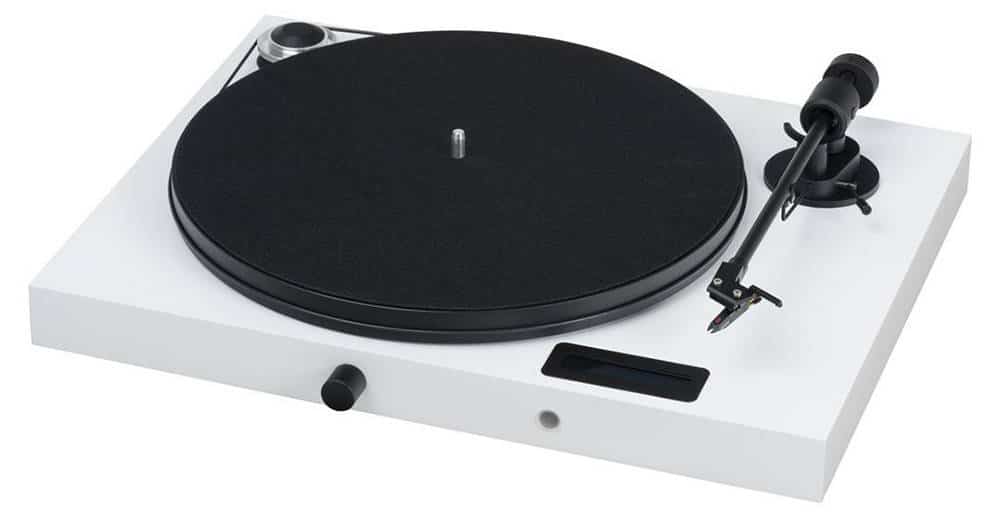
The Pro-Ject Juke Box E Vinyl Turntable is an all-in-one record-playing system designed to drive passive speakers without needing a separate amplifier or phono stage. It combines a belt-drive turntable, moving-magnet phono stage, Bluetooth receiver, line pre-amplifier and power amplifier in one compact chassis.
Watch the product video
Its natural audience is the vinyl beginner who wants a credible small-room stereo system with fewer boxes and cables. It is also a sensible option for anyone who already owns passive speakers and wants a simple way to play records, stream by Bluetooth, or connect a line-level source.
This review covers the original Juke Box E, not the later Juke Box E1 or the higher-spec Juke Box S2. That distinction matters because the related models use different specifications and should not be treated as interchangeable.
Design and build
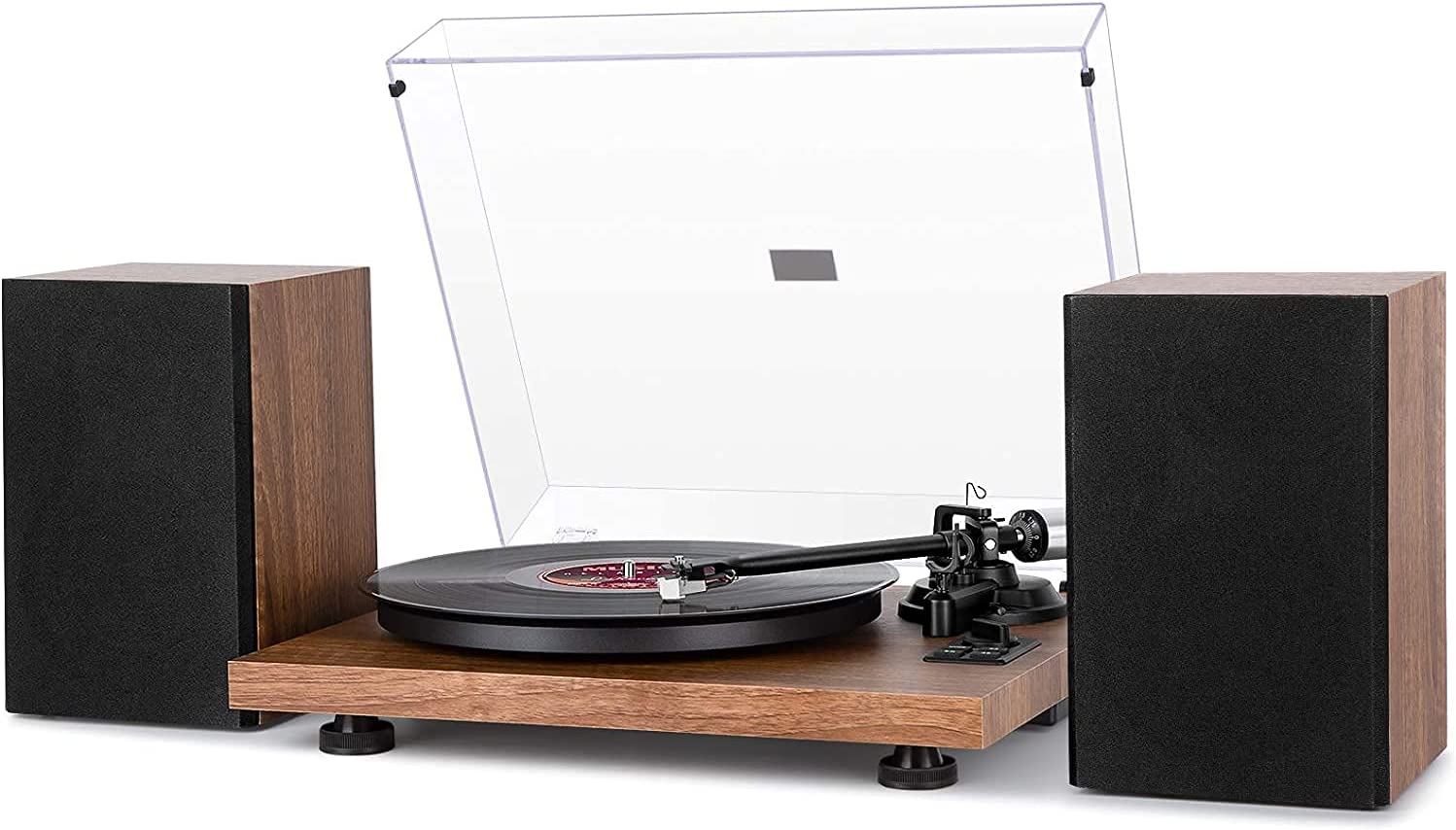
The Juke Box E follows Pro-Ject’s familiar minimalist turntable style, but with extra system controls built into the plinth. The high-gloss MDF body houses the turntable, amplification and input switching, with a top display and a front rotary/push control for everyday operation.
Core turntable parts include a perimeter belt-drive layout, a stainless-steel main bearing, a particle-board platter and a pre-set 8.6-inch aluminium tonearm. The supplied cartridge is an Ortofon OM 5E moving-magnet model, pre-mounted and pre-adjusted to reduce the amount of alignment work needed at first setup.
The rear panel provides the practical connections that make the product different from a normal entry-level deck. There are speaker outputs for passive speakers, line and phono outputs, a stereo line input and a Bluetooth antenna connection, while separate underside rocker switches control the turntable and amplifier sections.
Build-wise, it is best viewed as a compact starter hi-fi hub rather than a heavyweight separates component. It is more substantial and better conceived than record players with speakers built into the same cabinet, but its integrated construction inevitably limits upgrade flexibility compared with separate turntable, phono stage and amplifier boxes.
Features
The headline feature is the built-in power amplifier, rated at 2 x 50 W into 4 ohms, with review and retailer sources also describing 25 W per channel into 8 ohms. This lets the Juke Box E connect directly to passive loudspeakers, although reasonably sensitive speakers are the safer match if you want useful volume in a typical room.
A built-in MM phono stage means the Ortofon OM 5E cartridge can be used without buying a separate phono preamp. The phono and line outputs also add flexibility, allowing the turntable section or line-level signal to be fed into other hi-fi equipment if your system changes later.
Bluetooth is included as a receiver input, so a phone, tablet or computer can stream into the Juke Box E and play through the connected speakers. It should not be mistaken for Bluetooth output: the evidence supports wireless input only, not transmission to Bluetooth headphones or wireless speakers.
The stereo line input turns the unit into a small system hub for a CD player, streamer, TV audio output or similar line-level source. The remote adds volume, mute, input selection, bass, treble and loudness control, although the control logic is less conventional than using a separate integrated amplifier.
Setup
The Juke Box E is designed to be close to plug-and-play for beginners. The cartridge, tracking force and anti-skating are pre-set, so initial setup mainly involves placing it on a stable surface, fitting the belt, connecting the external 24 V power supply, attaching passive speakers and adding the Bluetooth antenna if required.
Daily use is simple once the controls are understood, but it is not as intuitive as a fully automatic deck or a conventional amplifier with separate input buttons. The underside power switches, standby procedure and manual belt speed change are all worth learning before regular use.
If buying used or clearance stock, check that essential parts are present and working, including the power supply, dust cover, remote, counterweight, belt and a healthy OM 5E stylus. It is also sensible to test Bluetooth, both amplifier channels, the line input, cueing action, motor noise and speed stability before committing.
Performance
In day-to-day use, the Juke Box E is manual rather than automatic. You cue the arm yourself, start and stop the motor manually, and change between 33 and 45 RPM by moving the belt on the stepped pulley.
Official figures state speed variance of 0.8% at 33 RPM and 0.7% at 45 RPM, with wow and flutter of 0.29% and 0.27% respectively. Those specifications place it in entry-level belt-drive territory, so buyers should expect competent home listening rather than the precision or convenience of more advanced decks with electronic speed control.
Connectivity is broad for such a compact unit, but the built-in amplifier is the main practical limit. With suitable passive speakers it is designed to be a neat small-room system, while insensitive speakers, large floorstanders or high-volume use may leave less headroom than a separate amplifier would provide.
The Bluetooth 2.1 + EDR receiver is useful for casual streaming, but it is dated by modern standards. For buyers who care strongly about wireless source quality, using a better external streamer into the line input is a more sensible long-term route.
Sound quality
The Juke Box E’s supported design points towards an easy-going compact hi-fi presentation rather than an audiophile separates experience. The Ortofon OM 5E is a credible entry-level cartridge with a replaceable elliptical stylus, and the choice of separate speakers avoids the vibration and stereo-imaging compromises of all-in-one record players with built-in speakers.
Professional assessments of the original model have broadly described it as balanced, approachable and enjoyable at moderate levels, with a slightly warm and forgiving character. The main reservations concern amplifier headroom, bass control, imaging focus and top-end sparkle when compared with stronger separates systems.
Speaker choice will have a large influence on the result. Reasonably sensitive passive speakers should help the built-in amplifier feel more comfortable, while inefficient speakers can make the system sound smaller or more strained than its specifications might suggest.
Vinyl should be treated as the primary source path here, with Bluetooth as a convenience feature. If streaming performance matters as much as record playback, an external line-level streamer is likely to be the better way to use the amplifier and speakers.
Pros
- All-in-one turntable, phono stage, Bluetooth receiver, pre-amplifier and power amplifier Drives passive speakers directly, reducing box count and cable clutter Pre-mounted Ortofon OM 5E cartridge with replaceable stylus Line input supports an extra source such as a CD player or streamer Line and phono outputs provide some system flexibility Separate speakers avoid the worst compromises of record players with built-in speakers
- Good practical fit for compact rooms and first vinyl systems
Cons
- Original Juke Box E is no longer available through the UK distributor, so stock may be used, old or limited
- Bluetooth is input only, not output to wireless headphones or Bluetooth speakers
- Manual belt change is required for 33/45 RPM speed switching Built-in amplifier can run out of headroom with insensitive speakers or larger rooms Less upgradeable than buying separate turntable, phono stage and amplifier components Control scheme and underside switches may take some getting used to
Verdict
The Pro-Ject Juke Box E remains an interesting solution because it does something most entry-level turntables do not: it can form a complete passive-speaker stereo system from one compact turntable chassis. For beginners who value simplicity, it is a more credible route into vinyl than a suitcase-style player with speakers built into the same cabinet.
Its compromises are equally clear. The amplifier has finite headroom, Bluetooth is only a convenience-grade input, speed change is manual and the all-in-one format cannot match separates for future upgrades or fault isolation.
As a used, clearance or leftover-stock purchase, it makes most sense when the condition is good, the essential accessories are included and the price reflects its discontinued status. If it costs close to a current new system, compare it carefully with the newer Juke Box E1 or a separate turntable and amplifier/speaker package before buying.