Introduction
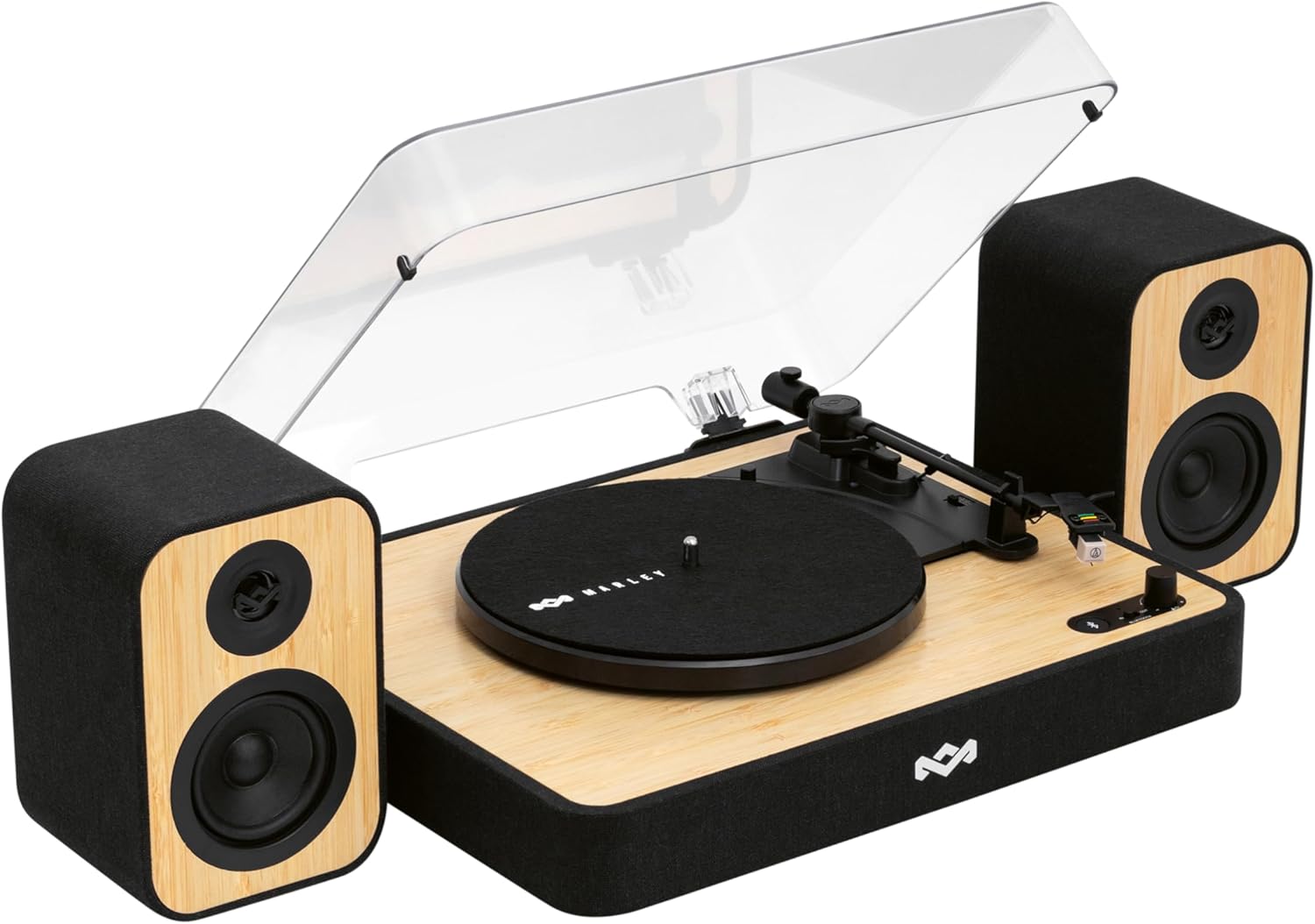
The House of Marley Revolution Wireless Turntable is a beginner-friendly Bluetooth record player designed for people who want vinyl playback without a complicated hi-fi setup. It is a standalone turntable, so it needs external speakers, headphones over Bluetooth, a soundbar, powered speakers or an amplifier to produce sound.
Watch the product video
Its appeal is as much about presentation and convenience as it is about records. The bamboo, fabric and recycled-plastic styling gives it a more considered look than many cheap all-in-one players, while Bluetooth input and output make it flexible for casual home use.
The product covered here is the standalone Revolution model, EM-JT004 / EM-JT004-SB. It should not be confused with the separate Revolution Turntable and Speakers bundle, which is a different package.
Design and build
The Revolution has a compact lifestyle design with House of Marley’s familiar emphasis on sustainable materials. Supported materials include bamboo, REWIND fabric and recycled plastics, along with a dust cover made from 100% post-consumer plastic.
It is laid out for straightforward use rather than detailed adjustment. The controls include an RPM switch, tonearm lift lever, Bluetooth button, Bluetooth IN/OUT switch, LED status indicator and a combined volume/power knob.
The tonearm uses a counter-balance weight, but the tracking force and anti-skate are pre-calibrated rather than presented as normal user adjustments. That suits nervous first-time buyers, though it limits the scope for fine-tuning.
Practical connections include RCA line output and passive speaker outputs. The passive outputs are not for powered speakers, so owners using active speakers should connect through the RCA line output or another suitable line-level route.
Features
Bluetooth is the headline feature because the Revolution can work in both directions. Bluetooth OUT sends record playback to compatible wireless speakers or headphones, while Bluetooth IN lets a phone, tablet or laptop stream audio through the turntable to connected wired speakers.
The turntable supports 33, 45 and 78 RPM speed selection, covering common LPs and singles as well as some 78 RPM records. Buyers interested in older shellac 78s should still check stylus suitability, as a standard LP stylus is usually not ideal for those discs.
The Audio-Technica AT3600L-type stylus is an appropriate entry-level choice for a starter deck. Evidence supports replacing the stylus with the same compatible type when worn, but this is not a platform for broad cartridge experimentation.
Auto-start and auto-stop add useful convenience without making the deck fully automatic. The platter starts when the tonearm is moved over the record and stops at the end, but the arm still needs to be cued and returned manually.
Setup
Setup is designed to be approachable. The user connects power, fits the counter-balance as instructed, removes the stylus guard, selects the correct speed and connects speakers by Bluetooth, RCA line output or the passive speaker terminals where appropriate.
Bluetooth OUT is used for sending vinyl playback to a speaker or headphones. Bluetooth IN is used for receiving audio from a phone, tablet or laptop, but speakers still need to be connected to the turntable’s outputs to hear that streamed audio.
Daily use remains partly manual, so the tonearm must be lifted, placed and returned by the user. The auto-start and auto-stop behaviour makes it less demanding than a fully manual deck, but it is not as hands-off as fully automatic alternatives.
Performance
Day-to-day operation is aimed at simplicity. Once speakers are connected and the speed is selected, the user manually cues the arm with the lift lever and the platter begins once the arm is positioned over the record.
The automation is limited but helpful. Auto-stop reduces the chance of the stylus sitting in the run-out groove indefinitely, although anyone expecting automatic tonearm return should choose a fully automatic model instead.
Connectivity is flexible for a deck at this level, particularly for homes already using Bluetooth speakers or a soundbar. However, Bluetooth can involve pairing friction, compression or latency depending on the receiving device, so wired RCA output remains the more dependable option.
Owner feedback is generally positive around ease of use, appearance and casual listening value, but there are some reports of Bluetooth being tricky and occasional comments about slow playback or distortion. The available evidence is not strong enough to treat those issues as universal, but they are worth bearing in mind when buying from a marketplace.
Sound quality
The Revolution should be judged as an accessible starter turntable rather than a specialist hi-fi component. Its AT3600L-type stylus, built-in electronics and pre-calibrated setup are sensible for convenience, but they also define its limits.
For casual vinyl listening through decent external speakers, the supported evidence points to a credible step above suitcase-style players. The final result will depend heavily on the speakers used, and pairing it with very basic speakers will restrict what the turntable can deliver.
Bluetooth output is useful, but it is not the purest route for records because the signal is transmitted digitally and may be affected by the receiving device. A wired RCA connection to powered speakers or an amplifier is likely to give the most stable and consistent presentation.
Specialist feedback available for this model characterises the sound as enjoyable for the price and intended use, while noting limits in refinement, dynamics and tonal control compared with more expensive decks. That is a fair context for expectations.
Pros
- Attractive bamboo, fabric and recycled-plastic design
- Bluetooth input and output add useful flexibility RCA line output for powered speakers or an amplifier Pre-calibrated setup is beginner-friendly Supports 33, 45 and 78 RPM speed selection Auto-start and auto-stop are helpful everyday conveniences Uses a replaceable AT3600L-type stylus
Cons
- No built-in speakers on the standalone model Not fully automatic and the tonearm does not return by itself Limited adjustability compared with more hi-fi-focused turntables Cartridge upgrade path appears limited
- Bluetooth pairing and playback quality may vary by speaker or headphones
- No confirmed dedicated headphone socket
Verdict
The House of Marley Revolution Wireless Turntable is a practical, attractive starter deck for buyers who value simple operation and flexible Bluetooth use. It offers a more credible route into records than many built-in-speaker players, but it still depends on suitable external speakers.
Its strengths are clear: distinctive materials, easy setup, useful wired and wireless connection options, and enough convenience for relaxed everyday listening. The trade-offs are equally important, including limited adjustment, no automatic arm return and no built-in speakers.
Buy it if you want a stylish first turntable that works well as part of a simple speaker setup. If you want fully automatic operation, cartridge upgrading or a more hi-fi-focused platform, a different beginner deck will be a better long-term choice.