Introduction
The House of Marley Revolution Wireless Turntable is a beginner-friendly Bluetooth record player aimed at people who want vinyl playback without a complicated hi-fi setup. It is a standalone turntable, so it needs external speakers, headphones over Bluetooth, a soundbar, powered speakers or an amplifier to make sound.
Watch the product video
Its appeal is strongest for first-time buyers, casual listeners and gift shoppers who want something more credible than a suitcase-style player. The Revolution also suits buyers drawn to House of Marley’s bamboo, fabric and recycled-plastic styling.
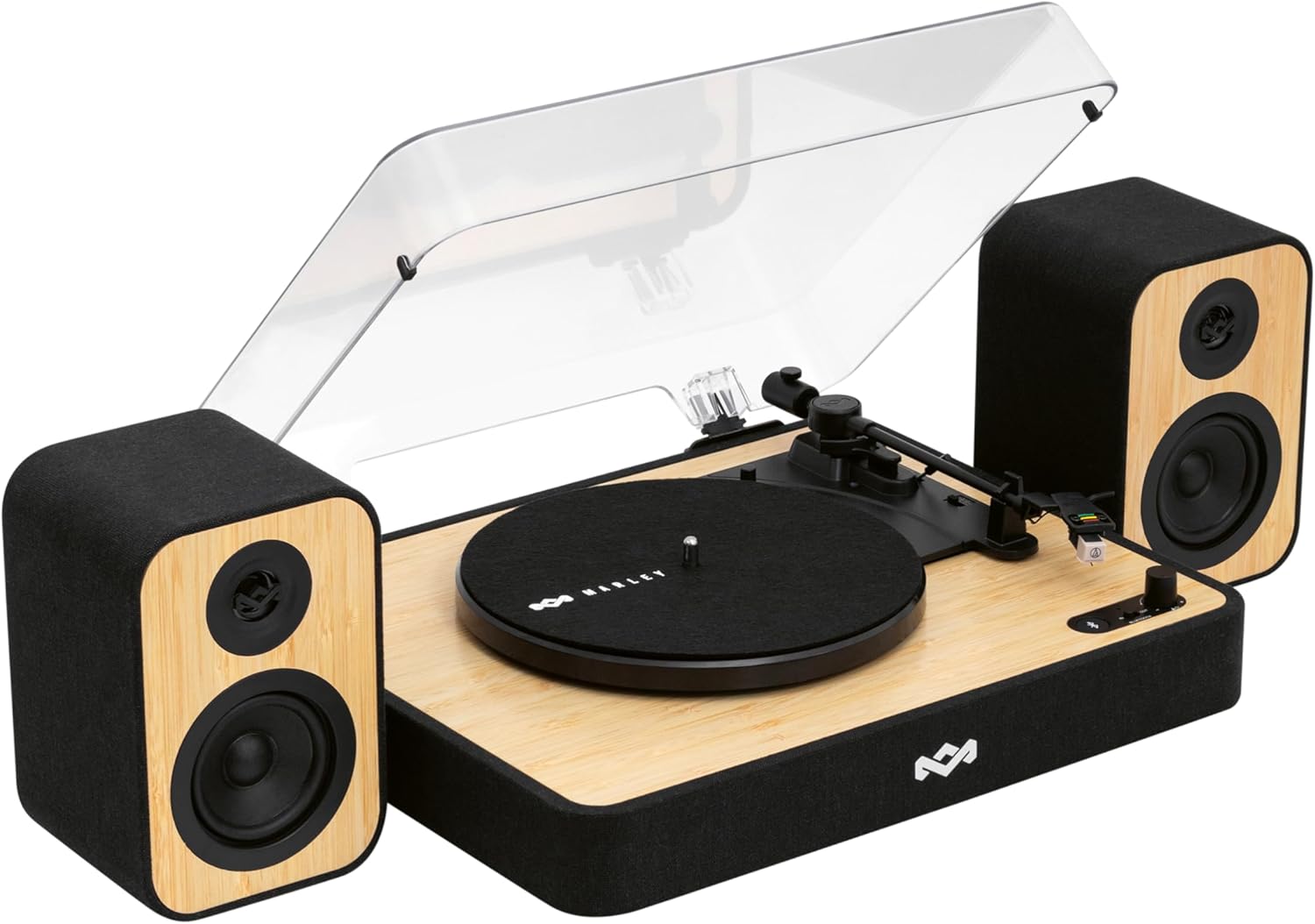
This review covers the standalone Revolution model, identified as EM-JT004 / EM-JT004-SB. It should not be confused with the separate Revolution Turntable and Speakers bundle, model EM-JT304.
Design and build
The Revolution has a compact lifestyle design built around visible sustainable-material choices. Supported materials include bamboo, REWIND fabric and recycled plastics, with a dust cover made from 100% post-consumer plastic.
The control layout is intentionally simple. The deck includes an RPM switch, tonearm lift lever, Bluetooth button, Bluetooth IN/OUT switch, LED status indicator and a combined power/volume knob.
It uses manual tonearm handling rather than a fully automatic mechanism. The platter starts when the arm is positioned over the record and stops at the end, but the arm itself must be cued and returned by hand.
The construction is better understood as convenient and decorative rather than enthusiast-grade. Tracking force and anti-skate are pre-calibrated, which keeps setup easy but limits fine adjustment.
Features
Bluetooth is the headline feature, and the Revolution supports both Bluetooth OUT and Bluetooth IN. OUT sends vinyl playback to compatible Bluetooth speakers or headphones, while IN lets a phone, tablet or laptop stream through the turntable to wired speakers connected to its outputs.
For wired systems, the RCA line output is the most straightforward connection for an amplifier, powered speakers or a suitable line-level input. The deck also has passive speaker outputs, but active or powered speakers should not be connected to those terminals.
The supplied Audio-Technica AT3600L-type stylus is a sensible entry-level choice for a starter deck. Evidence supports replacing the stylus with the same compatible type when worn, but this is not presented as a broad cartridge-upgrade platform.
Three-speed playback covers 33, 45 and 78 RPM records. Buyers interested in old shellac 78s should still check stylus suitability, as standard LP styli are usually not ideal for those discs.
Setup
Setup is designed for beginners. The process involves connecting power, fitting the counter-balance as instructed, removing the stylus guard, selecting the correct speed and connecting speakers by Bluetooth, RCA line output or passive speaker output.
For Bluetooth OUT, the switch is set to OUT before pairing with a speaker or headphones. For Bluetooth IN, the switch is set to IN, but external wired speakers must be connected to hear the streamed audio.
The most important practical caution is speaker matching. Use RCA line out for powered speakers, and do not connect active speakers to the passive speaker outputs.
Performance
Day-to-day operation is designed to be low-fuss. Choose the speed, cue the arm with the lift lever and let the auto-start/auto-stop function handle the platter motor at the beginning and end of play.
The automation is limited, so expectations matter. This is not a fully automatic turntable and there is no supported evidence of automatic arm return.
Connectivity is flexible for a starter product, especially if you want to use an existing soundbar, Bluetooth speaker or powered speaker setup. Bluetooth pairing may take a little learning, and owner comments include occasional reports of pairing difficulty.
Speed and playback feedback is mostly positive in owner summaries, but not flawless. A small number of comments and one professional assessment mention slow playback or distortion, so buyers wanting a more adjustable, performance-led deck should look higher up the market.
Sound quality
The Revolution should be judged as a casual entry-level Bluetooth turntable rather than a hi-fi specialist deck. Its AT3600L-type stylus, built-in line output and pre-calibrated setup prioritise accessibility over tuning flexibility.
Available professional feedback describes the sound as enjoyable for everyday listening at this level, while also noting limits in fullness, dynamics and tonal refinement compared with more expensive turntables. Reported reservations include midrange and treble shortcomings, and sound balance can vary depending on the connected speaker.
A wired RCA connection is likely to be the more stable route where sound quality is the priority. Bluetooth remains useful for convenience, but it can involve compression, latency or pairing friction depending on the speaker or headphones used.
Speaker choice will have a major effect on the final result. Pairing the Revolution with decent powered speakers or an amplifier and speakers is likely to be more rewarding than treating it as a self-contained music system.
Pros
- Attractive bamboo, fabric and recycled-plastic design
- Bluetooth input and output add useful connection flexibility RCA line output for powered speakers or an amplifier Pre-calibrated setup is approachable for first-time buyers Auto-start and auto-stop reduce day-to-day fuss Supports 33, 45 and 78 RPM speed selection
- More credible starter option than many suitcase-style players
Cons
- No built-in speakers on the standalone EM-JT004 model Not fully automatic
- the tonearm does not return itself Limited adjustment and cartridge-upgrade potential
- No confirmed dedicated headphone socket
- Bluetooth pairing and playback quality may vary by speaker or headphones Box contents should be checked, as RCA cable inclusion is not consistently supported
Verdict
The House of Marley Revolution Wireless Turntable is a stylish, practical starter deck for buyers who want vinyl, Bluetooth and simple operation in one neat package. Its strongest points are its approachable setup, distinctive materials and flexible connection options.
It is not the right choice for users expecting a complete all-in-one player or a fully automatic turntable. The lack of built-in speakers, limited adjustability and modest upgrade path are important trade-offs.
For casual listening with suitable external speakers, the Revolution makes sense as an easy first turntable. If automatic operation or long-term cartridge upgrading matters more, alternatives from Audio-Technica, Sony, JBL or similar brands may be a better fit.