Introduction
The GPO Chesterton Record Player is a retro all-in-one music centre for vinyl, CDs, cassettes, FM radio, USB playback and wired Aux sources. It is aimed at listeners who want one tidy tabletop unit rather than a separate turntable, amplifier and speakers.
This is best understood as a convenience product for casual listening, mixed media collections and simple USB recording. It suits bedrooms, studies, guest rooms and living spaces where appearance and ease of use matter as much as outright audio performance.
For clarity, the supplied product information aligns with the standard non-DAB Chesterton, also identified in official material as the T298-KD. Buyers who specifically want DAB/DAB+ radio or confirmed Bluetooth should check for the separate Chesterton DAB variant or listing-level confirmation.
Design and build
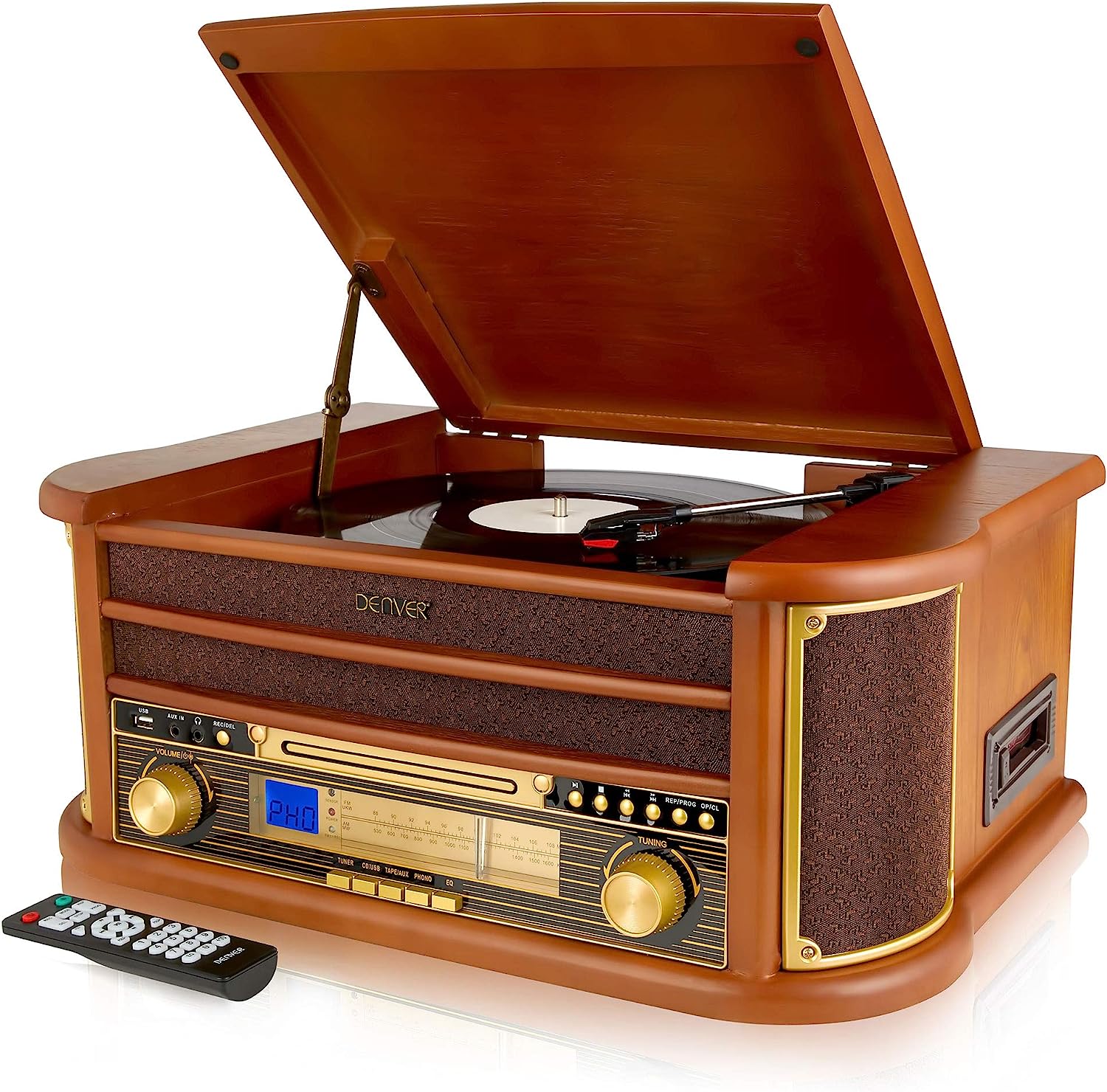
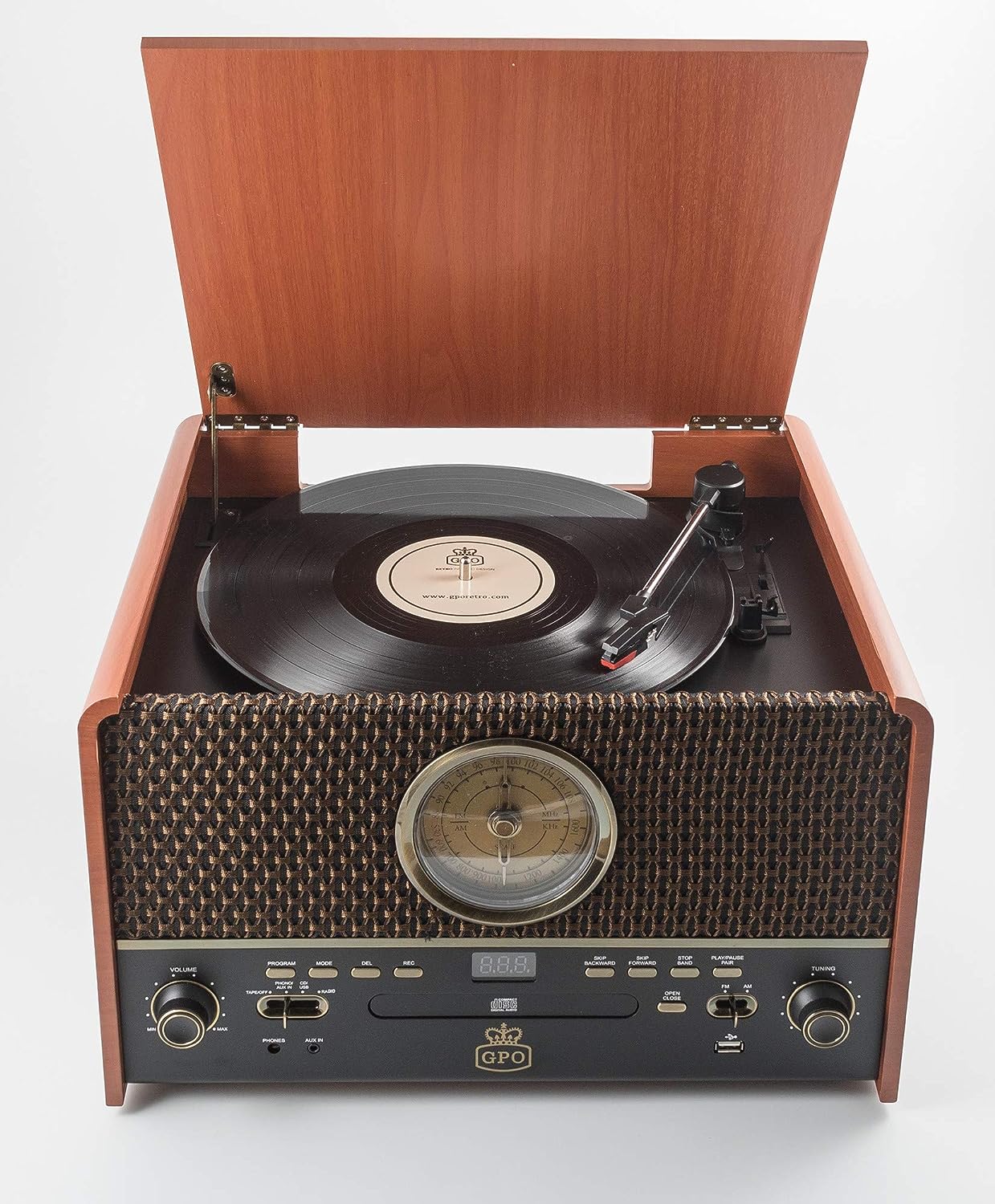
The Chesterton uses a nostalgic wood-effect cabinet with the record deck set into the top beneath a dust cover. Its furniture-like styling is a major part of the appeal, especially for buyers who want a traditional look without assembling a full hi-fi system.
Controls are spread across the unit in a practical way. The turntable area includes a tonearm clip, cueing lever, speed selector and auto-stop switch, while the front panel carries the display, CD tray, USB port, Aux input, headphone socket and main source controls.
The cassette deck is side-loading, and the rear panel includes the power connection, FM antenna and line output. This layout keeps the unit compact, though it also means the amplification, speakers, turntable and other sources are all built into one cabinet.
Construction is therefore convenience-led rather than component-led. It is designed to replace several small playback devices, not to provide the adjustment, isolation or upgrade flexibility of a dedicated turntable setup.
Features
The headline feature is multi-format playback. The Chesterton can handle records, standard audio CDs, compatible data CDs, cassettes, FM radio, USB music files and a 3.5 mm Aux input, making it useful for households with several older formats still in use.
USB recording is another practical attraction. The manual states that it can record from LP, CD, MP3 disc, FM radio, cassette and Aux input to a USB flash drive, which is helpful for simple archiving or casual MP3 creation without a computer interface.
The turntable offers 33, 45 and 78 rpm speed settings, plus auto-stop. The 78 rpm setting should be treated carefully, however, because the official material does not specify a 78-compatible stylus, and shellac records normally require the correct stylus type.
Built-in stereo speakers rated at 2 x 2 W make the Chesterton self-contained. There is also a rear line output for connection to an amplifier or compatible speaker system, which is the more sensible route if stronger sound is required.
Setup
Setup is designed to be approachable. Place the unit on a flat, stable surface, release the tonearm clip, remove the stylus guard, select the source and speed, then use the cueing lever to lower the stylus onto the record.
CD, USB, FM, cassette and Aux operation follows the front-panel source controls, with cassette playback starting after insertion. For USB recording, insert a compatible FAT32 drive, select the source, press record and stop the recording when finished.
The remote control adds convenience for some CD and USB-style functions, though everyday use still depends on the unit’s physical controls. AAA batteries are required for the remote and are not specified as included in the supplied evidence.
Performance
Day-to-day operation is straightforward, but the record deck is not fully automatic. The user still places the record, selects the speed, cues the arm and returns it after playback, while auto-stop can help prevent the stylus from remaining in the run-out groove.
The manual notes that auto-stop may stop some records before the final track, in which case it can be switched off. That is useful flexibility, but it also shows the mechanism is basic rather than a precision automatic system.
No official wow/flutter, signal-to-noise or speed-accuracy figures are available, so performance should not be judged as if this were a specialist hi-fi deck. The Chesterton’s strength is breadth of playback rather than documented turntable engineering.
Connectivity is practical for a unit of this type. USB playback supports several common file formats, but drives must be FAT32 and 32 GB or smaller, with folder file-count limits; Bluetooth should not be assumed for this exact non-DAB model unless the retailer listing clearly states it.
Sound quality
The Chesterton’s sound expectations should be set by its design. With 2 x 2 W built-in speakers in a compact all-in-one cabinet, it is likely to be most appropriate for casual listening, background music, radio and older media rather than deep bass, high volume or wide stereo imaging.
Owner feedback available for the non-DAB Chesterton is limited but generally positive about ease of use and acceptable sound for the format. Those comments are useful context, but they are not a substitute for measured performance data or specialist listening tests.
The official information does not specify the cartridge model, stylus profile or tracking force. That makes it difficult to make strong claims about fidelity or long-term record care, especially for valuable vinyl collections.
For a better audio result, the rear line output is the key option. Feeding a suitable amplifier or powered speaker system should provide more headroom and separation than the small built-in speakers, although it will not turn the Chesterton into a fully adjustable hi-fi turntable.
Pros
- Attractive retro wood-effect cabinet with compact all-in-one layout Plays vinyl, CD, cassette, FM radio, USB files and wired Aux sources
- Can record several sources to a USB flash drive Built-in 2 x 2 W stereo speakers make it self-contained Rear line output allows connection to an amplifier or compatible speaker system 33, 45 and 78 rpm speed settings, with caution needed for 78 stylus suitability Auto-stop can reduce stylus wear in the run-out groove
Cons
- Not a serious hi-fi turntable and lacks published cartridge, tracking force and performance specifications Built-in speakers are modest and will limit bass, volume and stereo separation
- Bluetooth is not confirmed for this exact non-DAB model
- No DAB/DAB+ radio on the standard Chesterton covered here Auto-stop may stop some records early and may need switching off USB drives must be FAT32, 32 GB or smaller, with folder file-count limits
Verdict
The GPO Chesterton Record Player is a practical retro music centre for people who want broad format support in one compact cabinet. Its appeal lies in convenience, appearance and the ability to play or record several media types without building a separates system.
Its limitations are equally clear. The small built-in speakers, unspecified cartridge details and lack of published turntable performance figures mean it should not be chosen as a serious vinyl platform.
As a casual all-in-one for mixed collections, it makes sense if you accept those trade-offs and verify any listing-dependent features such as Bluetooth. For better vinyl sound and record-care confidence, a dedicated turntable with separate speakers remains the stronger long-term choice.